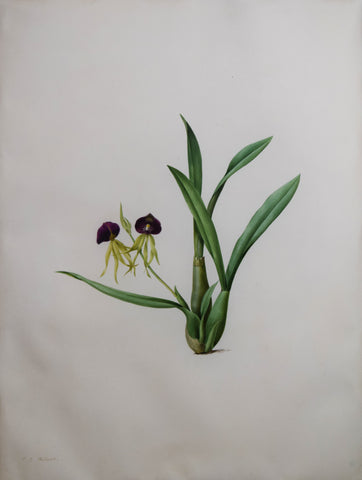
Pierre-Joseph Redouté (Belgian, 1759-1840), “Clamshell Orchid or Larger Yellow Ladyslipper” Ependendrum cochleatum
Pierre-Joseph Redouté (Belgian, 1759-1840)
Watercolor for plate 346: “Clamshell Orchid or Larger Yellow Ladyslipper” Ependendrum cochleatum
Prepared for Les Liliacées ca. 1802-1816
Watercolor and graphite on vellum
Completed: ca. 1802-1816
Vellum size: 18 3/8 x 13 1/4 in.
Frame: 25 x 19 1/2 in.
Signed ‘P.J. Redouté’ lower left
Inventory no. AP02050
The Ependendrum cochleatum in Les Liliacées is today classified as Prosthechea cochleata (clamshell orchid or cockle orchid), a member of the family Orchidaceae. The common name “ladyslipper” in the catalog is a misnomer reflecting early confusion in orchid nomenclature; the plant bears no resemblance to a slipper orchid (Cypripedium). Its actual flowers are strikingly distinctive: dark purple to maroon, clamshell-shaped lips (the species name cochleatum means snail- or clamshell-shaped) face upward, surmounting reflexed yellow-green petals and sepals that hang downward.
Native to Central and northern South America (the West Indies, Colombia, Venezuela, and Guyana) and extending north to Florida, Prosthechea cochleata was among the earliest New World orchids to be cultivated in European botanical gardens. It arrived in Paris through the French colonial networks in the West Indies and through contacts with Spanish and Portuguese botanical gardens, which had better access to New World material than the French through their colonial connections in Mexico, Peru, and Brazil.
The inclusion of orchids in Les Liliacées is an unusual choice; orchids are not members of the lily order, but it reflects the publication’s expansive conception of the monocotyledon flora available in French botanical gardens. In the early nineteenth century, systematic classification of monocotyledons was still in flux, and authorities had not yet definitively established the boundaries between lily-relatives and orchid-relatives. The clamshell orchid’s presence in the publication thus illuminates a moment in the history of plant classification when the limits of the “lily family” were still being debated.
Orchid cultivation in Paris in the early nineteenth century was a specialist pursuit, confined to the largest and best-equipped botanical institutions. Josephine’s greenhouse at Malmaison was one of the few private establishments that could maintain orchid specimens at the sustained temperatures and humidity levels the plants required. The clamshell orchid, with its extraordinary inverted flower structure and vivid coloring, would have been among the most visually striking of Josephine’s botanical possessions. Redouté’s vellum captures the orchid’s unusual character with the same botanical precision he applied to more familiar plant families.
Please feel free to contact us with questions by phone at 215.735.8811,
or by email at loricohen@aradergalleries.
We Also Recommend