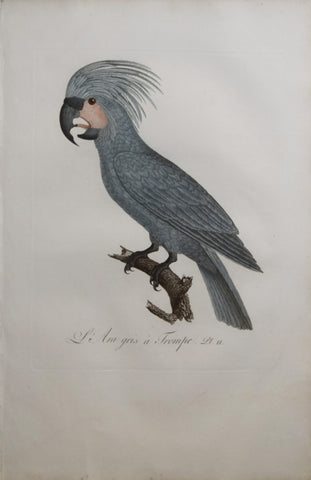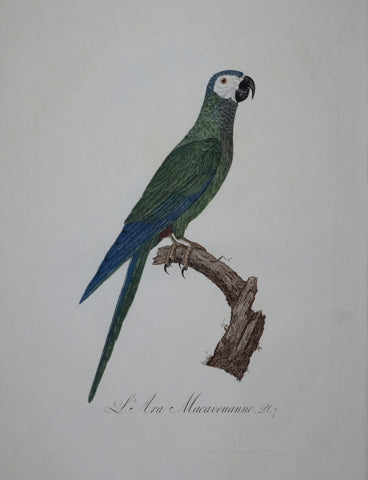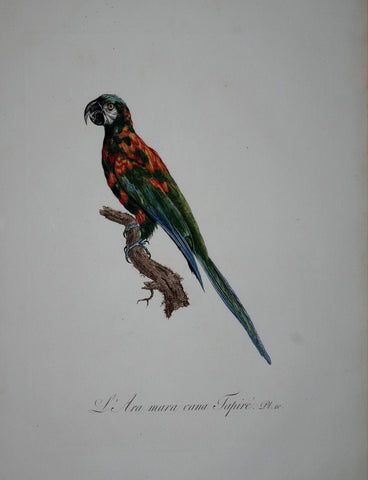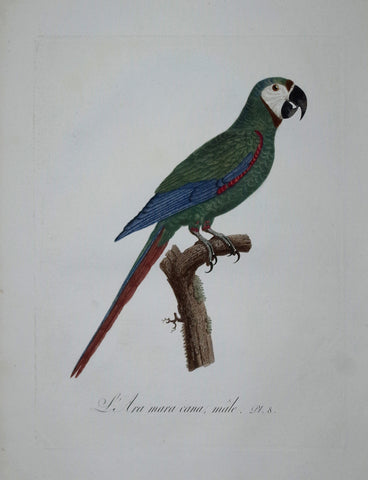
Jacques Barraband (1767-1809)
Histoire des Perroquets
Paris, 1801-1805
Engravings with original hand-coloring
Born in 1767, Barraband received his artistic training under Joseph Malaine, a distinguished flower painter who held the prestigious title of peintre du roi (painter to the king) under Louis XVI. This apprenticeship was consequential in several respects. Malaine’s specialty in botanical and floral subjects instilled in his pupil a sensitivity to organic form and surface texture, as well as an exacting approach to the rendering of natural specimens that would define Barraband’s mature work. Working under a court-appointed artist also oriented the young Barraband toward the networks of royal and aristocratic patronage that would sustain his career throughout his life. The habits of precision, elegance, and decorative refinement expected in works destined for royal interiors would prove equally suited to the demands of luxury natural history publishing.
Following his training, Barraband secured a position as a designer and draftsman at the Manufacture des Gobelins in Paris, the celebrated tapestry works that had served as a royal manufactory since the reign of Louis XIV. The Gobelins had for over a century supplied the French court and aristocracy with tapestries of extraordinary technical and artistic complexity, their weavers working from painted cartoons of the highest quality. Barraband’s role there required him to produce designs adaptable to the loom, encouraging an approach to line and color that was simultaneously bold in compositional structure and refined in detail. The experience of designing for a medium that demanded clarity of contour and careful modulation of color gradients may well have sharpened the very qualities that distinguish his bird illustrations: the decisive, clean outlines that define each subject’s silhouette, and the layered, nuanced tonal passages that describe plumage with such vivid naturalism.
The work that secured Barraband’s lasting reputation was his partnership with the French naturalist and explorer François Levaillant, for whom he created the original watercolors that served as the basis for the hand-colored engravings. Levaillant, who had undertaken extensive travels in southern Africa between 1781 and 1784, returned to France with an extraordinary collection of bird specimens and field observations that he would spend the following decades publishing in a series of monumental folio volumes. These were luxury publications conceived for wealthy collectors and institutional libraries, their engraved plates colored by hand to approximate the qualities of the original paintings. The collaboration produced some of the finest illustrated natural history books of the age.
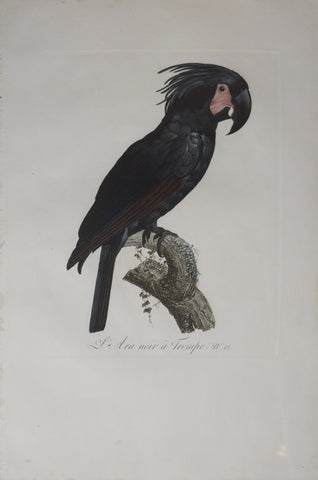
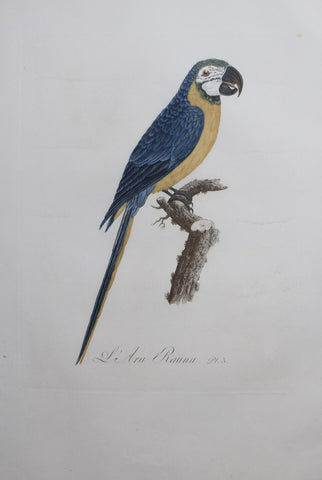
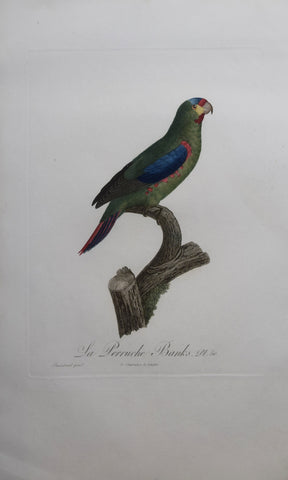
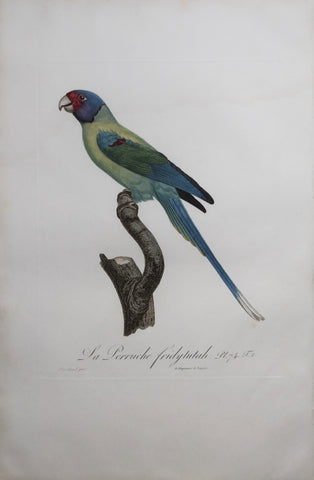
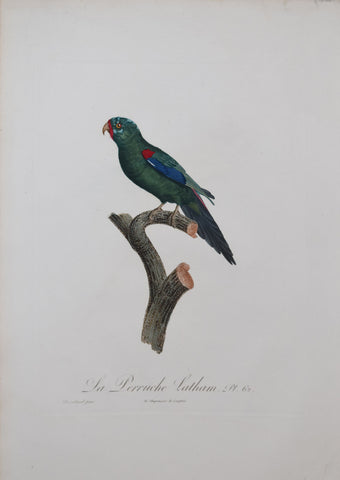
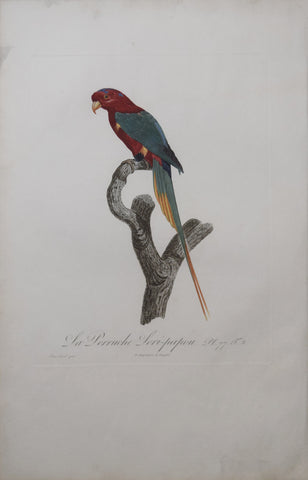
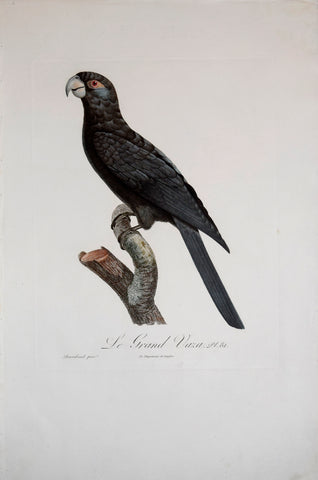
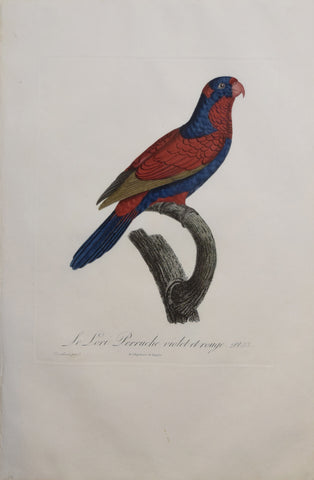
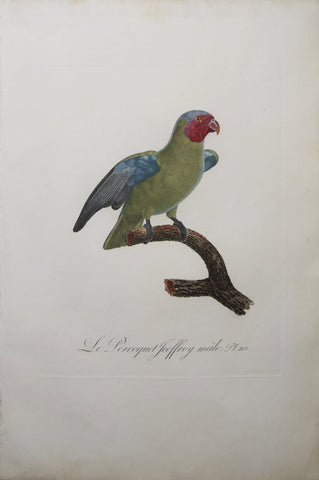
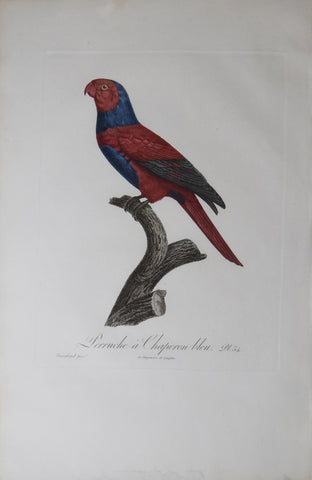
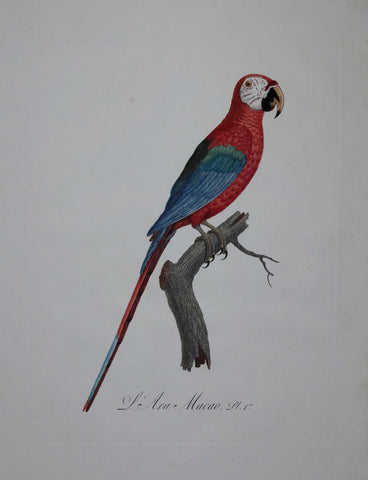
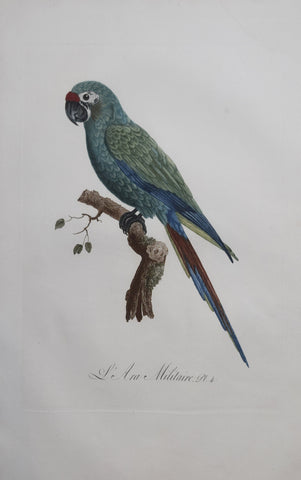
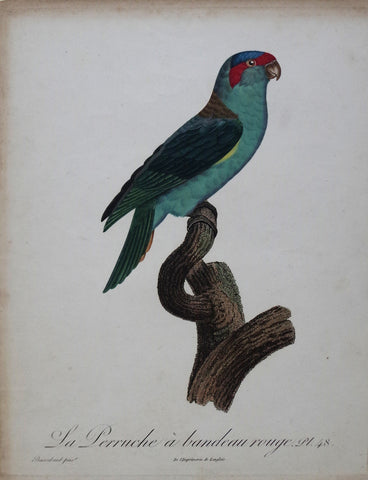
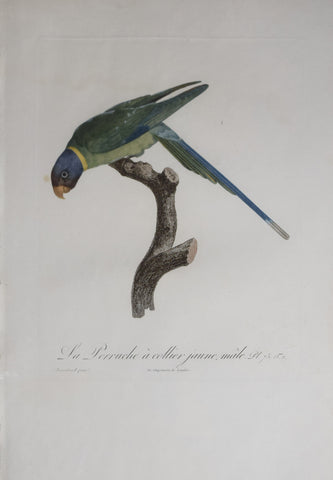
The Histoire naturelle des perroquets (Natural History of Parrots), published between 1801 and 1805, contained 145 plates after Barraband’s watercolors and remains the most celebrated fruit of the partnership. The parrots of Africa, South America, and the Indo-Pacific represented a remarkable range of form and coloration, from the massive and architecturally structured plumage of macaws to the jewel-like compactness of lovebirds and pygmy parrots. Barraband rendered each species with a consistency of approach that is itself an achievement: every bird is presented in a posture that reveals its characteristic silhouette and displays its most distinctive plumage to advantage, typically set against a spare or simply indicated background that throws the subject into sharp relief. Yet within this consistent compositional framework, the individual character of each species is fully and convincingly realized.
The technical means by which Barraband achieved his effects are worth examining in some detail, because the printed engravings, however beautifully produced, do not fully convey what is visible in the original watercolors. Each feather is described not as a flat shape of uniform color, but through dozens of fine parallel lines that follow the feather’s structure, building up a richly textured surface in which color and tone modulate continuously across the form. This technique produces an optical effect of remarkable sophistication: the plumage reads as simultaneously flat, in the manner of a decorative image, and three-dimensional, with the sheen and depth of actual feathers. The meticulous hand-colored engravings in Levaillant’s publications could approach but not fully capture the delicate modulations of tone and color, the fine lines, and the perfect draftsmanship of Barraband’s originals, which are exceptional in their richness and tonal variation.
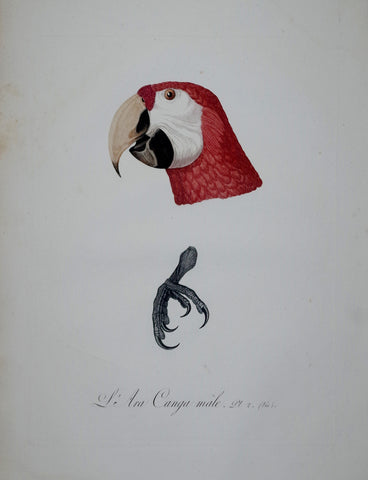
The scientific accuracy of these images is equally striking. Working from preserved specimens as well as from living birds, Barraband captured not only the color and pattern of plumage but its structural logic: the way feathers overlap and interlock, the scaling of different feather types across the body, and the precise form of bills and feet adapted to different feeding habits and environments.
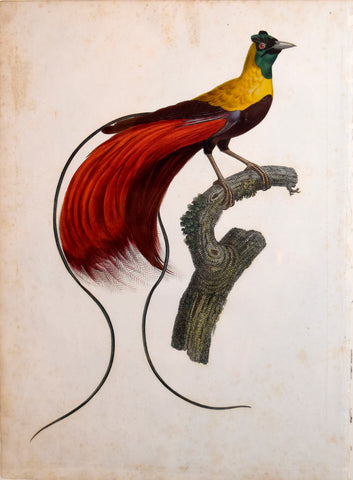
Barraband’s second major collaboration with Levaillant, the Histoire naturelle des oiseaux de paradis (Natural History of Birds of Paradise), published between 1801 and 1806, posed different challenges. The birds of paradise of New Guinea and the surrounding islands are among the most extravagantly ornamented of all birds, the males bearing elaborate plumes, wires, fans, and filaments deployed in courtship displays of extraordinary complexity. Translating these forms into the conventions of natural history illustration required Barraband to stretch his technique in new directions, finding ways to render the iridescent, metallic qualities of certain plumes and the dramatic spatial extension of others. The resulting watercolors are among his most ambitious compositions, their subjects posed to display the full decorative splendor of their ornaments while remaining convincingly alive and naturalistic.
The enthusiasm with which French audiences received Barraband’s images of tropical and African birds was not purely aesthetic. The early years of the nineteenth century were a period of intense French engagement with the natural world beyond Europe, driven in part by the scientific expeditions that accompanied Napoleon’s military campaigns. The Egyptian expedition of 1798 to 1801, which brought not only soldiers but also a commission of nearly 170 scholars, scientists, and artists charged with documenting the natural and cultural history of Egypt, had profoundly stimulated French curiosity about the flora, fauna, and peoples of Africa. The monumental Description de l’Egypte, the multivolume publication that resulted from the expedition, embodied a characteristically Napoleonic ambition to command nature and culture alike through systematic documentation.
Against this background, Barraband’s images of African birds carried a charge beyond their beauty as natural history illustrations. They participated in a broader cultural appetite for the exotic, for the visual possession of distant and unfamiliar worlds rendered legible and beautiful through the conventions of French art. The parrots of equatorial Africa, the birds of paradise of the Pacific, the birds of paradise of the African interior that Levaillant had encountered on his travels: all arrived in Barraband’s watercolors transformed from raw natural specimens into objects of civilized French contemplation, their strangeness domesticated by the refinement of his technique without being diminished.
Barraband’s connections to the structures of French royal and imperial power were not merely circumstantial. His training under a painter to Louis XVI, his work at the Gobelins, his participation in the Paris Salons throughout the Consulate and early Empire periods, his provision of designs to the Manufacture de Sèvres in 1806: all of these locate him firmly within the networks of artistic production that served the French state and its ruling class across the upheavals of the Revolution and the establishment of Napoleon’s empire.
The most direct expression of these connections was his decoration of the dining room in Napoleon’s chateau at Saint-Cloud, a commission that placed his work in one of the principal residences of the Emperor himself. Saint-Cloud, situated on the heights above the Seine to the west of Paris, had been a royal residence since the seventeenth century and, under Napoleon, served as a principal seat of government and ceremonial. To be entrusted with the decoration of a room in such a setting was a significant mark of official favor, and the choice of a painter known above all for his images of birds and natural subjects suggests that the decorative program at Saint-Cloud may have shared something of the broader imperial interest in natural history that found expression in the Egyptian expedition and in the scientific ambitions of the period more generally.
The most personally significant of Barraband’s imperial connections, however, was his relationship with the Empress Josephine. Josephine Bonaparte was one of the most consequential patrons of natural history art in the early nineteenth century. At her estate of Malmaison, outside Paris, she maintained a celebrated garden and an extensive menagerie that housed an extraordinary collection of exotic animals and birds brought from the furthest reaches of the French empire and beyond. The garden at Malmaison, developed with the guidance of the botanist Etienne Pierre Ventenat and illustrated by the great botanical painter Pierre-Joseph Redouté, became famous throughout Europe as a repository of rare and beautiful plants. The menagerie was equally remarkable, stocking species from Australia, South America, Africa, and Asia that were virtually unknown in Europe at the time.
Josephine’s interest in these living collections was not merely that of a wealthy collector; she understood that they represented unique opportunities for scientific documentation and wished to preserve records of her rarer specimens in artistic form. It was in this spirit that she purchased several gouaches of birds by Barraband from the Salon of 1808 and subsequently commissioned from him paintings of particularly extraordinary varieties from the aviary at Malmaison. These commissioned works gave
Barraband access to living specimens of species rarely, if ever, painted from life, and the resulting images carry a quality of directness and vitality that reflects this unusual opportunity.
The commission also placed Barraband in distinguished company. Josephine employed the greatest natural history artists of the period to document the living collections at Malmaison, among them Redouté for the botanical subjects and Precht van Gélder for certain animal subjects. To be numbered among the artists selected by the Empress for this purpose was both a professional honor and a mark of the high esteem in which Barraband’s gifts were held by the most sophisticated patrons of the age.
Alongside his work for private and imperial patrons, Barraband participated in the public life of the French art world through regular exhibitions at the Paris Salon, the official exhibition of the Académie des Beaux-Arts that remained the primary arena of artistic reputation throughout the Napoleonic period. He exhibited at the Salons of 1798, 1799, 1800, 1802, 1804, and 1806, presenting works that attracted favorable critical notice and helped establish his standing beyond the specialized world of natural history publishing. Salon participation exposed his work to a broader public than the wealthy collectors who purchased Levaillant’s expensive folios, and the critical reception of his exhibited works confirms that his contemporaries recognized in him something more than a scientific illustrator.
The subjects Barraband chose to exhibit suggest an artist who understood the relationship between natural history painting and the broader tradition of French decorative and fine art. His images of exotic birds occupied a space between scientific illustration, animal painting, and decorative work, giving them an unusual versatility of appeal in a specialist genre. They could be appreciated as documents of natural science, as objects of exotic curiosity, as examples of virtuoso technique, and as works of genuine pictorial beauty.
Jacques Barraband died in 1809, at the age of forty-two, cutting short a career that had already achieved remarkable distinction but, had it continued, might have produced an even larger body of work. He left behind a legacy, above all in the watercolors for the Levaillant publications, works recognized as masterpieces in their own time and have retained that status ever since. The originals, now dispersed among public and private collections, continue to astonish viewers with the combination of scientific precision and painterly refinement that Barraband brought to the ornithological subjects that defined his career. As both documents of the natural world as it was understood and imagined in Napoleonic France and as objects of pure visual beauty, they occupy a place in the history of natural history art that no subsequent development has diminished.