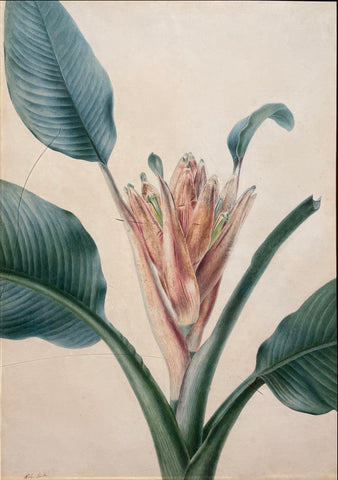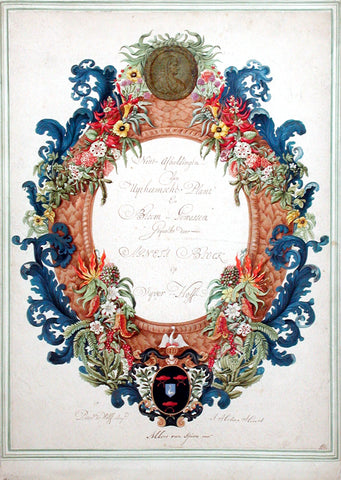

John Frederick Miller (British, active 1772-1796), Money Tree (Pachira aquatica)
John Frederick Miller (British, active 1772-1796)
[Money Tree (Pachira aquatica)]
Preparatory drawing for “Carolinea princeps Tab XXXVII” in Icones animalium et plantarum (Miller’s icones) London, 1776-85
Watercolor, pencil and ink on paper
Inscribed ‘perhaps these may be curious (?) therefore taken the liberty of
sending them for the ...’
‘from St. Lucia by Mr. Anderson to Mr. Foresyth Gardiner to Kensington’
Signed ‘John Frederick Miller del. 1784’
Paper size: 18 1/2 x 12 1/2 in.
# AP01708
Carolinea princeps, a synonym for Pachira aquatica) is commonly known as the money tree. It is a popular houseplant often sold with braided trunks, symbolizing good luck, prosperity, and positive energy in Feng Shui. The money tree is native to Southern Mexico, Bolivia, and Northern Brazil and is found in freshwater swamps, estuaries, along riverbanks, or tropical rainforests. The genus name, Pachira, means “sweetwater nut’ and refers to the tree’s fruits. The specific epithet, aquatica, is Latin for “aquatic.”
This drawing is inscribed “perhaps these may be curious (?) therefore taken the liberty of sending them for the ...from St. Lucia by Mr. Anderson to Mr. Foresyth Gardiner to Kensington.”
William Forsyth (1737–1804), the Scottish botanist appointed Superintendent of the Royal Gardens at Kensington and St. James’s Palace in 1784, was a natural figure within the Banks-Miller world. Forsyth trained under Philip Miller at Chelsea and later used Icelandic lava obtained via Banks to build one of Britain’s earliest rock gardens. As the keeper of extensive living collections at the royal gardens, Forsyth was well positioned to supply rare and ornamental plant subjects to the illustrators working within the Banks circle, including Miller, whose Cimelia Physica plates include a number of elegant plant portraits appearing in print for the first time.
The “Mr. Anderson” most plausibly connected to Miller’s world is Alexander Anderson (c.1748–1811), Superintendent of the Botanic Garden at St. Vincent from 1785 and one of Banks’s most productive Caribbean correspondents. Anderson gathered specimens across Barbados, Grenada, Trinidad, Guyana, and St. Lucia, sending rare plants including true cinnamon northward through the Banks network. His St. Lucia contacts supplied him with botanically significant material. Specimens flowing from Anderson through Banks’s Soho Square establishment would naturally have reached Miller’s drawing table, and some of the Caribbean plant plates in Icones animalium et plantarum may well originate in Anderson’s collecting.
John Frederick Miller was born into one of London’s most accomplished natural history households. His father, Johann Sebastian Müller (1715–c.1790), emigrated from Nuremberg in 1744 after training under the engraver Johann Christoph Weigel, and spent his career at the intersection of Linnaean botany and copper engraving. The elder Miller worked closely with Philip Miller of the Chelsea Physic Garden, illustrated Philip Miller’s Figures of the Most Beautiful, Useful and Uncommon Plants (1755–60), and produced all plates for Lord Bute’s Botanical Tables (1785). His most ambitious achievement, the twenty-part Illustratio Systematis Sexualis Linnaei (1770–1777), earned direct praise from Linnaeus himself. Two of the elder Miller’s twenty-seven children, John Frederick and his brother James, followed their father into natural history illustration.
Growing up in a studio where botanical specimens, Linnaean taxonomy, and engraving technique were everyday currency gave John Frederick both his scientific literacy and his visual discipline. His formal training was almost certainly conducted under his father before he moved into the orbit of Sir Joseph Banks.
Through his father’s scientific connections, John Frederick was taken into the employment of Sir Joseph Banks (1743–1820), serving as one of Banks’s principal draftsmen from around 1768. His first major assignment was drawing the artefacts and specimens returned by Cook’s Endeavour voyage (1768–71), and he and James also worked up finished watercolors from Sydney Parkinson's field sketches, which had been completed before the expedition returned.
John Frederick and brother James were selected to accompany Banks on Cook’s second voyage, but the plan collapsed when Banks withdrew from the expedition. Instead, in 1772, John Frederick accompanied Banks on a journey to the Orkneys, Hebrides, and Iceland. His watercolor drawings from the Iceland trip are now held at the Natural History Museum, London, and have served as a primary source for subsequent natural history publications, including Thomas Pennant’s Arctic Zoology (1784–7). Banks continued to supply Miller with zoological and botanical specimens received from correspondents around the world, giving him access to subjects from southern Africa, the Americas, the East Indies, and the Pacific.
Between 1776 and 1785, Miller issued Icones animalium et plantarum in ten parts, sixty hand-colored engravings drawn, etched, and published by the author himself. The work is of extreme rarity, with only two incomplete copies known to survive. Despite this, it is scientifically significant: some of its binomial names are the earliest valid epithets for the species depicted, and the plates serve as holotypes for seven bird species, including the king penguin, the secretarybird, the crested caracara, and the extinct Tahiti crake.
In 1796, the plates were reissued as Cimelia Physica. Figures of Rare and Curious Quadrupeds, Birds, etc. Together with Several of the Most Elegant Plants, printed by T. Bensley for Benjamin and John White at Horace’s Head in Fleet Street, with descriptive text by the naturalist George Shaw. The sixty plates cover birds, quadrupeds, and plants from five continents. Many are sepia-printed and heightened with gum arabic, a technique that lends them a watercolor depth and transparency. The compositional pairing of animals with relevant plants recalls Mark Catesby’s earlier American natural history work. Several plant plates represent the first published illustration of the depicted species.
Miller’s work sits precisely at the intersection of art and Enlightenment natural philosophy. He worked primarily in watercolor, supplemented by the engraving and etching required to translate originals into printed form. His technique balanced scientific precision with aesthetic coherence: the plates are accurate enough to carry formal taxonomic weight yet composed and colored with the care of objects intended to be beautiful. Working from real specimens rather than from earlier prints, he brought to each subject the observational discipline his father had modeled and the access to first-hand material that Banks uniquely provided.
We Also Recommend