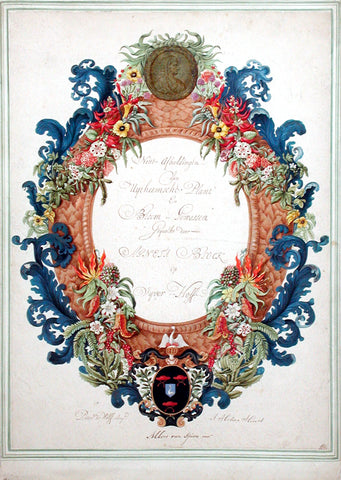

Georg Dionysius Ehret (German, 1708-1770), Aloe Guinensis radice geniculata folis e viridi & alri undulatum variegalis (The Guinea aloe)
ALOE; Guineensis radice geniculata, foliis e viridi & atro undulatim variegatis
(The Guinea aloe with a jointed root and leaves variegated in waves of green and black)
[Bowstring Hemp, Dracaena hyacinthoides, syn. Sansevieria hyacinthoides]
Watercolor on paper
Signed ‘G. D. Ehret’ lower right
Paper size: 21 1/4 x 15 in.
Two great blades of leaf, banded in rippling waves of dark and pale green, rise like flames on either side of a tall, rose-flushed stalk. At its summit a spire of slender white flowers bursts open in a spray of fine stamens. To the right, drawn in the most delicate outline, Ehret has added a few individual florets taken apart for study. These small dissections are a signature of his Linnaean training, for it was the number and arrangement of a flower’s reproductive parts on which the new system of classification depended.
Despite its old name, the plant is not a true aloe. Ehret’s inscription repeats the phrase name published by Caspar Commelin of the Amsterdam botanic garden in Praeludia Botanica (Botanical Preludes, 1703), and Commelin’s plate later became the reference specimen for the species Linnaeus called Aloe hyacinthoides, known today as Dracaena (formerly Sansevieria) hyacinthoides. The epithet Guineensis reflects where Europeans believed the plant came from rather than where it actually grows. Modern botanists place it in eastern and southern Africa, from Kenya south to South Africa. In the seventeenth and early eighteenth centuries, however, “Guinea” served as a loose label for much of Africa’s Atlantic trade, and plants frequently acquired the name of the coast or port through which they passed. Dutch East India Company ships, calling at the Cape of Good Hope on their way home from Asia, carried a stream of African succulents to the gardens of Amsterdam and Leiden, and from there they spread to the collections of English enthusiasts.
Several qualities made the plant a favorite. Its thick, creeping rootstock (the “jointed root” of the inscription) could survive months at sea and years of neglect. In Africa its tough leaf fibers were twisted into bowstrings and cordage, giving rise to the English name “bowstring hemp,” a detail that appealed to an age fascinated by useful plants. The serpentine banding of the leaves was a curiosity in itself, and the flowers, which open toward evening, are sweetly fragrant. Today the plant’s close relatives, the snake plants, are among the most familiar houseplants in the world, which lends a particular charm to this portrait from the days when it was still a rarity grown only in princely and scholarly gardens.
Born in Heidelburg to a market gardener, Ehret began his working life as a gardener’s apprentice, eventually becoming a chief gardener for the Elector of Heidelburg and the Margrave of Baden, whose prize tulips, and hyacinths he painted. Ehret soon moved on to several cities across Europe, collecting eminent friends and important patrons as he traveled. His list of benefactors included the most brilliant and celebrated natural history enthusiasts of his day, among whom was Dr. Christopher Trew, a wealthy Nuremberg physician who became his lifelong patron, friend, and collaborator. From 1750 until Ehret’s death in 1770, he and Trew collaborated on the publication of the important illustrated volumes Plantae Selectae and Hortus Nitidissimus, both of which added to the rising acclaim for the artist’s considerable talents as a botanical painter. Also, Ehret’s admirers were the Parisian naturalist Bernard de Jussieu and the great Swedish naturalist Linnaeus, and Ehret’s illustrations are some of the first works to reflect the Linnaean system of classification.
Ehret was one of the first artists to focus on exotic species from across the Atlantic, and his draftsmanship was so fine that his friend and colleague, the great artist/naturalist Mark Catesby, used at least three of the German painter’s botanical illustrations for his seminal Natural History of Carolina, Florida, and the Bahama Islands. Today, Ehret’s images are widely considered the most desirable to emerge from that monumental publication, and he collaborated with Catesby in other ways, too, in the compilation of the Natural History, offering advice or adding significant elements to Catesby’s initial compositions. Catesby was influenced greatly by Ehret’s accomplished style, especially in the representation of three-dimensionality, but the older artist was never able to attain the same high level of meticulous realism and vitality. Ehret, in turn, drew on a few Catesby’s discoveries and observations in his own work. Unlike Catesby, Ehret was never able to travel to America but became fascinated with examples of New World flora that he saw in English natural history collections, such as that of Peter Collinson, a friend, and patron of both artists. Painted just at the time of the publication of Catesby’s Natural History, these watercolors are spectacular early representations of American flora.
In England, where he eventually settled, Ehret became the only foreigner to be elected a Fellow of the Royal Society. Though Ehret’s work is best known through printed illustrations done in collaboration with Trew, even his impressive engravings cannot compare with the vibrancy, color, and detail of the original paintings. Only in his remarkably sensuous and accurate watercolors is the full extent of his mastery and sensitivity clear. Ehret’s delicate modulations of tone and shadow bring vitality to these exquisite original watercolors, belying their ostensibly documentary purpose. His distinctive style transcends scientific illustration, achieving a level of beauty that has rarely been equaled in the history of botanical art.
or by email at loricohen@aradergalleries.
We Also Recommend