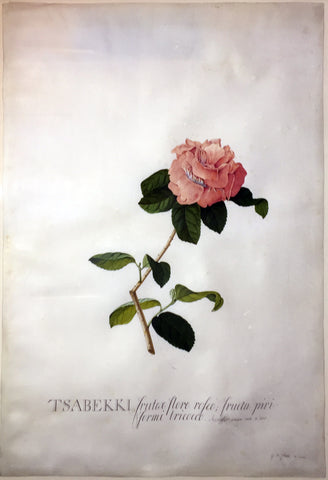
Georg Dionysius Ehret (German, 1708-1770), Tsabekki fructae flore rosio fructu piri formio tricico [Japanese Camellia, Camellia japonica]
TSABEKKI frutex flore roseo, fructu piri formi tricocco. Kaempfer Amoen.
(Tsubaki, a shrub with a rose-colored flower and a pear-shaped, three-lobed fruit. Kaempfer, Amoenitates.)
[Japanese Camellia, Camellia japonica]
Watercolor on vellum
Signed and dated lower right: G. D. Ehret 1742; inscribed with title
Vellum size: 20 3/4 x 14 3/8 in. Frame size: 31 1/4 x 24 1/4 in.
Inventory no. AP01494
A single stem of glossy, finely toothed leaves carries one sumptuous flower, its coral-pink petals layered in tiers like those of an old garden rose. It is no accident that Ehret’s contemporaries knew the camellia as the “Japan Rose.”
Camellia japonica is native to Japan, southern Korea, eastern China, and Taiwan. In Japan, where it is called tsubaki, it had been cultivated for centuries in temple and palace gardens and valued for the oil pressed from its seeds. Europe first learned of it in detail from Engelbert Kaempfer, the German physician who served the Dutch East India Company at its trading post in Nagasaki harbor in 1690-1692, when Japan was otherwise closed to foreigners. His Amoenitatum Exoticarum (Exotic Delights, 1712) described the plant under its Japanese name, and Ehret’s inscription, with its reference to Kaempfer, borrows his description directly.
Living camellias reached England only in the late 1730s, almost certainly by way of the East India Company’s trade with China. The first to flower, a single red and a single white, were grown by Robert James, 8th Baron Petre, in the famous hothouses of Thorndon Hall in Essex, the greatest private plant collection of its day. A few years later the naturalist George Edwards recalled that “this beautiful flowering Tree was raised by the late curious and noble Lord Petre in his Stoves at Thorndon-Hall in Essex.” Lord Petre was a close friend of Peter Collinson, Ehret’s patron, and died of smallpox in July 1742, the very year inscribed on this drawing. Ehret’s drawing thus belongs to the first years of the camellia’s life in Europe, and it ranks among the earliest European images of the plant. The double pink form he painted is not among those recorded at Thorndon, which leaves open the intriguing question of whether he worked from another living plant, a dried specimen, or an imported Chinese painting; what is certain is that very few Europeans had yet seen a camellia in flower at all. After Petre’s death his gardener, James Gordon, established a nursery at Mile End and was the first to offer camellias commercially, beginning the plant’s long reign in English conservatories.
The camellia captivated its first audiences for many reasons. It was an evergreen that flowered in the depths of winter, a quality almost unknown among garden shrubs. It was a near relative of the tea plant, Camellia sinensis, at a moment when Britain was drinking ever more tea and dreaming of growing its own. And it came from Japan, a country Europeans knew chiefly through the reports of Kaempfer and through the lacquer, porcelain, and painted wallpapers on which camellias so often bloomed.
Born in Heidelburg to a market gardener, Ehret began his working life as a gardener’s apprentice, eventually becoming a chief gardener for the Elector of Heidelburg and the Margrave of Baden, whose prize tulips, and hyacinths he painted. Ehret soon moved on to several cities across Europe, collecting eminent friends and important patrons as he traveled. His list of benefactors included the most brilliant and celebrated natural history enthusiasts of his day, among whom was Dr. Christopher Trew, a wealthy Nuremberg physician who became his lifelong patron, friend, and collaborator. From 1750 until Ehret’s death in 1770, he and Trew collaborated on the publication of the important illustrated volumes Plantae Selectae and Hortus Nitidissimus, both of which added to the rising acclaim for the artist’s considerable talents as a botanical painter. Also, Ehret’s admirers were the Parisian naturalist Bernard de Jussieu and the great Swedish naturalist Linnaeus, and Ehret’s illustrations are some of the first works to reflect the Linnaean system of classification.
Ehret was one of the first artists to focus on exotic species from across the Atlantic, and his draftsmanship was so fine that his friend and colleague, the great artist/naturalist Mark Catesby, used at least three of the German painter’s botanical illustrations for his seminal Natural History of Carolina, Florida, and the Bahama Islands. Today, Ehret’s images are widely considered the most desirable to emerge from that monumental publication, and he collaborated with Catesby in other ways, too, in the compilation of the Natural History, offering advice or adding significant elements to Catesby’s initial compositions. Catesby was influenced greatly by Ehret’s accomplished style, especially in the representation of three-dimensionality, but the older artist was never able to attain the same high level of meticulous realism and vitality. Ehret, in turn, drew on a few Catesby’s discoveries and observations in his own work. Unlike Catesby, Ehret was never able to travel to America but became fascinated with examples of New World flora that he saw in English natural history collections, such as that of Peter Collinson, a friend, and patron of both artists. Painted just at the time of the publication of Catesby’s Natural History, these watercolors are spectacular early representations of American flora.
In England, where he eventually settled, Ehret became the only foreigner to be elected a Fellow of the Royal Society. Though Ehret’s work is best known through printed illustrations done in collaboration with Trew, even his impressive engravings cannot compare with the vibrancy, color, and detail of the original paintings. Only in his remarkably sensuous and accurate watercolors is the full extent of his mastery and sensitivity clear. Ehret’s delicate modulations of tone and shadow bring vitality to these exquisite original watercolors, belying their ostensibly documentary purpose. His distinctive style transcends scientific illustration, achieving a level of beauty that has rarely been equaled in the history of botanical art.
or by email at loricohen@aradergalleries.
We Also Recommend