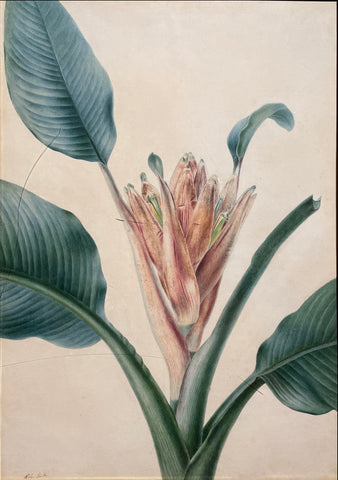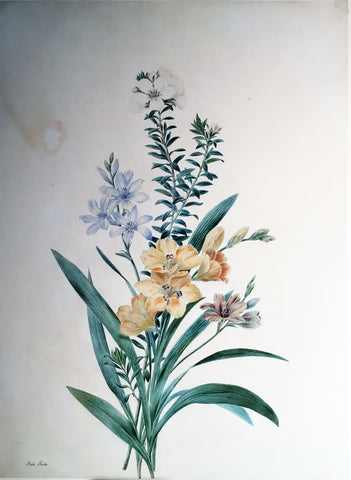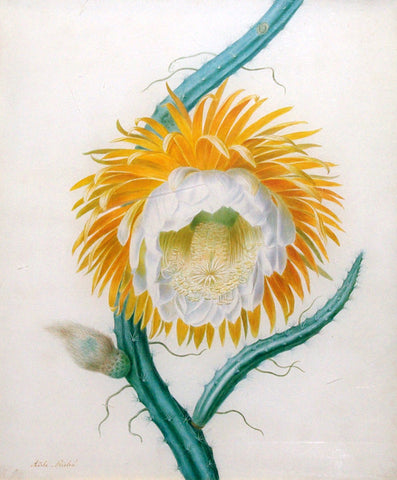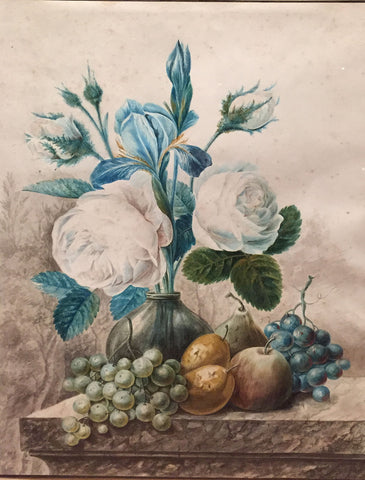

Charles Empson (British, 1794-1861), Teliapteris Rotonidfolia
CHARLES EMPSON (BRITISH, 1794-1861)
Teliapteris Rotonidfolia (Round-leaved Tetrapteris)
From an album of 100 drawings of tropical, chiefly South American, plants
Watercolor and graphite with touches of gum Arabic on paper, laid down on grey mount
Inscribed in graphite: “Teliapteris Rotonidfolia/St Hillire (?)” lower right
Mount inscribed “69” upper right
England, ca. 1830-1845
Paper size: 15 ½ x 10 ¼ in. Mount size: 20 x 13 5/8 in.
Inventory no. AP01223
Provenance: Painted for Mrs. Jane Elizabeth Gough (d. 1848); by inheritance to her brother, John Moore Paget, 1848, together with the artist’s Narratives of South America (1836), inscribed to that effect;¹ a Gentleman; his sale, Sotheby & Co., London, 27 July 1953, (as “a superb collection of 100 drawings”), to Charles W. Traylen; private collection; Sotheby’s, Monaco, 12 December 1984, lot 3341, to W. Graham Arader III.
The inscription appears to read Tetrapteris rotundifolia, naming a member of Tetrapterys, a genus of climbers and shrubs in the Barbados cherry family (Malpighiaceae). The name means four-winged, for the fruits, and the rounded, opposite leaves and branched clusters of small flowers with clawed petals are consistent with the family.
Tetrapterys is distributed through tropical America from Mexico to Argentina, chiefly in forests and savanna woodlands.
Together with the Hiraea and Byrsonima in this group, the sheet suggests a particular interest on Empson’s part, or on the part of an advisor, in the Malpighiaceae, a family whose classification was being actively revised in the 1820s and 1830s.
Charles Empson, a print and watercolor dealer in Bath, England, spent three years traveling the northern part of South America, for the most part, in what is now Colombia, from 1824 to 1827. His original drawings of the exotic plants of South America, which he first encountered on that journey, introduce an artist of superb technique and achievement better known through the narratives of his travels in South America. Empson traveled from Cienega, on the northern coast of Colombia, through the central and eastern cordilleras of the Andes to Honda, in the south, via the river Magdalena, and east into Venezuela. His recollections of the trip preserved in his ‘Narratives of South America,’ published in London in 1836. “The glorious descriptions of Humboldt had induced many persons who had no other motive beyond that of beholding Nature in all her majesty, to explore these regions so gorgeously clothed in primeval vegetation, and so abundant in every production interesting to mankind. It was my happiness to associate with many travelers who had established themselves in the Republic before any of the European nations had acknowledged the independence of Columbia, and had shared in the vicissitudes of the revolutionary war; but they found ample compensation for all their privations in the inexhaustible variety of the new world. A field so rich, and so extensive, proved an irresistible temptation to the scientific man; the produce and commercial demands of so vast a continent were not less attractive to the merchant, while scenes of grandeur and beauty offered the most fascinating allurements to the imagination of the enthusiast.” (Preface). Empson was accompanied by his friend Robert Stephenson, son of the famous railway engineer. They returned with precious objects of pre-Colombian art, including some gold artifacts which Charles later exhibited in Newcastle-upon-Tyne. Unfortunately, some of their possessions were lost in a shipwreck at the entrance to New York harbor, and only three known portfolios of his South American inspired artwork are known.
Please feel free to contact us with questions by phone at 215.735.8811,
or by email at loricohen@aradergalleries.
We Also Recommend