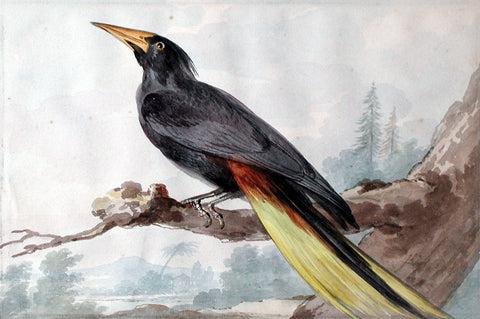


William Matthew Hart (British, 1830-1908), Quetzal, or Pharomacrus mocinno. Pharomachrus mocinno (Resplendent Quetzal)
The Resplendent Quetzal lives in the montane cloud forests of Central America, from Chiapas in southern Mexico through Guatemala, Honduras, El Salvador, Nicaragua, and Costa Rica to western Panama, generally between about three thousand and ten thousand feet. It feeds mainly on wild avocados and other fruits of the laurel family and nests in cavities in soft, rotten wood, often old woodpecker holes, because its bill is too weak to excavate sound timber. The species is classified as Near Threatened, and its forests have been reduced by clearance.
The Maya and the peoples of central Mexico considered the quetzal sacred, reserving its plumes for the headdresses of rulers and priests and associating it with the feathered serpent Quetzalcoatl. Long tail plumes reached Europe after the Spanish conquest, but as Gould notes, European science knew almost nothing of the bird until the nineteenth century. By the 1870s, skins arrived from collectors in Guatemala and Costa Rica, and the quetzal became the most coveted cabinet trophy. Today, it is the national bird of Guatemala, appears on its flag and coat of arms, and has given its name to the national currency since 1925.
This is the finished watercolor from which the opening plate of Gould’s revised monograph on the trogons was lithographed and colored, and it is the most ambitious composition in the work. Hart places a male quetzal at the mouth of a nesting cavity hollowed in a decaying trunk, his golden-green train sweeping upward and doubling back across the upper right of the sheet in two great arcs. Within the hollow, the female leans forward, her duller head and gray breast set against the shadow so that the male’s scarlet underparts read as the single burning note of the picture. Three more birds occupy the middle and far distance, perched on slender branches above a pale wash of cloud forest and tree fern, a device that let Gould present the species in the round without a second plate.
What the eye reads as a tail is in fact a pair of enormously elongated upper tail coverts, and Hart is careful to show the true tail beneath them, its outer feathers white, in the distant birds. The foreground carries a spray of white orchids, bracket fungi along the fallen limb, and the bleached stub of a broken branch, all handled with a naturalist’s attention to decay as well as display. Hart worked in transparent washes for the distance and the bark, then built the plumage in opaque bodycolor, drawing individual barbs with the point of the brush before glazing the greens and reds with gum arabic, which imparts a low, wet gloss that mimics iridescence and shifts as the sheet is turned toward the light. This technique made his hummingbird plates famous, and no hand-colored lithograph can quite reproduce it.
Gould issued his first trogon monograph in three parts between 1835 and 1838, with thirty-six plates drawn largely by himself and Elizabeth Gould; the quetzal appeared there on the work’s only folding plate. By the late 1850s, new collecting in Mexico and Central America had transformed knowledge of the family, and Gould returned to the subject. The second edition, issued in parts and completed in 1875, has forty-seven hand-colored plates, with the text rewritten and every plate redrawn. Its plates set the birds in fully realized habitats of tropical flora, epiphytes, and forest, with additional figures showing sex, age, and behavior, a change of program largely the work of Hart, by then the dominant artist on Gould’s plates. Returning the quetzal to the head of the sequence in a still grander composition was a deliberate statement about the bird and about the book.
The pencil inscription at upper left is the sheet’s most revealing detail, because it is a working instruction rather than a title. Gould directed the botanical settings of his plates as closely as the birds, and here he names the plant he wanted. Barkeria elegans, described by Knowles and Westcott in 1838, is now treated as a synonym of Barkeria uniflora, a slender epiphytic orchid of central and southwestern Mexico with pale lilac to white flowers; the white orchids of the lower register answer the instruction. Since the orchid does not grow in the quetzal’s cloud forests, the pairing is artistic rather than ecological, a reminder that Gould composed his plates for beauty as well as accuracy. Very few drawings for the Trogonidae survive with such an instruction still legible.
Gould’s text for the quetzal, adapted from his first edition, is among the most quoted passages he wrote:
It is scarcely possible for the imagination to conceive any thing more rich and gorgeous than the golden-green colour which adorns the principal part of the plumage of this splendid bird, or more elegant and graceful than the flowing plumes which sweep pendent from the lower part of the back, forming a long train of metallic brilliancy.
Gould also records that birds from the southern part of the range carry narrower plumes, a character on which Jean Cabanis separated the Costa Rican population in 1869. Cabanis’s bird survives as the southern subspecies, Pharomachrus mocinno costaricensis.
WILLIAM MATTHEW HART (BRITISH, 1830-1908)
The talented natural history painter William Matthew Hart was the artistic genius behind some of the lavish illustrations for John Gould’s splendid work The Birds of Great Britain and A Monograph of the Trochilidae or family of Hummingbirds.
He began working for Gould in 1851, beginning an association that was to last thirty years. Early during this period, he made the patterns for the lithographic plates for Gould’s work on hummingbirds and working on The Birds of Great Britain with Henry Constantine Richter. By 1870, Hart had become Gould’s chief artist and lithographer. After Gould died in 1881, Hart was employed by Richard Bowdler-Sharpe of the British Museum to complete Gould’s work on the birds of New Guinea and to produce illustrations for Sharpe’s monograph on the birds-of-paradise.
Hart is roundly regarded as Gould’s most devoted protegé and his most accomplished artist, drawing upon Gould’s incomparable legacy of research and craftsmanship to create a splendid tribute to Gould and his favorite birds.
Please feel free to contact us with questions by phone at 215.735.8811,
or by email at loricohen@aradergalleries.
We Also Recommend