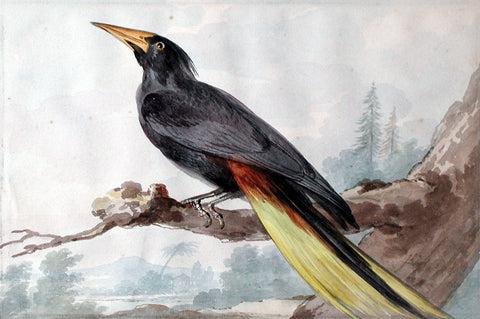

William Matthew Hart (British, 1830-1908), Macgregor’s Bird of Paradise (Cnemophilus macgregorii)
The Crested Satinbird lives in the high montane forests and forest edges of central and eastern New Guinea, up to about eleven thousand feet. The male is flame orange to scarlet above, including the crown and tail, and black below, with a small crest of fine, wiry plumes that is usually concealed in the crown feathers and raised in display; the female is plain olive-brown. The nominate race, figured here, inhabits the mountains of southeastern New Guinea, where it was discovered; a redder race, sanguineus, occurs in the central highlands.
For a century, people classed the bird as a bird of paradise, and its English name, the Sickle-crested Bird-of-paradise, reflects that. In 2000, however, molecular studies showed that the satinbirds are not birds of paradise at all but a separate family, the Cnemophilidae, whose closest relatives are uncertain. Sharpe himself had hesitated, placing the genus among the bowerbirds, and his text quotes P. L. Sclater’s careful weighing of its affinities. The drawing thus records a bird whose true identity eluded the best ornithologists of the age.
The species was discovered by Sir William Macgregor, administrator of British New Guinea, during his ascent of the Owen Stanley Range in 1889, and was described by C. W. De Vis of the Queensland Museum in 1890. At the time of Sharpe’s monograph, only a single specimen, an adult male, was known.
Two males stand on a mossy branch high in the mountains: one, seen from the front, shows the black underparts; the other, seen from behind, shows the flame-orange back, wings, and tail; both raise the thin crests that gave the species its old name. Snow-capped peaks and a misty valley in the background evoke the Owen Stanley Range where the bird was found. The pencil note “Paradise Part 4” identifies the part of Sharpe’s monograph in which the plate appeared.
Sharpe’s text records that the figure was drawn “from a picture painted by Mr. Keulemans” of the type specimen, which had been sent from Brisbane to London for examination. Hart’s watercolor thus stands at the end of a chain of images, from the unique specimen to J. G. Keulemans’s painting to this finished design for the lithographer, and the second, rear view of the bird represents Hart’s own reconstruction.
This remarkable form was discovered by Sir William Macgregor during his expedition to the Owen Stanley Mountains, and was procured at Mount Knutsford, at an elevation of 11,000 feet.
The figure in the Plate has been drawn from a picture painted by Mr. Keulemans from the type specimen which Mr. De Vis so kindly sent to England for examination.
WILLIAM MATTHEW HART (BRITISH, 1830-1908)
The talented natural history painter William Matthew Hart was the artistic genius behind some of the lavish illustrations for John Gould’s splendid work The Birds of Great Britain and A Monograph of the Trochilidae or family of Hummingbirds.
He began working for Gould in 1851, beginning an association that was to last thirty years. Early during this period, he made the patterns for the lithographic plates for Gould’s work on hummingbirds and working on The Birds of Great Britain with Henry Constantine Richter. By 1870 Hart had become Gould’s chief artist and lithographer. After Gould died in 1881, Hart was employed by Richard Bowdler-Sharpe of the British Museum to complete Gould’s work on the birds of New Guinea and to produce illustrations for Sharpe’s monograph on the birds-of-paradise.
Hart is roundly regarded as Gould’s most devoted protegé and his most accomplished artist, drawing upon Gould’s incomparable legacy of research and craftsmanship to create a splendid tribute to Gould and his favorite birds.
Please feel free to contact us with questions by phone at 215.735.8811,
or by email at loricohen@aradergalleries.
We Also Recommend