
William Henry Jackson (1843-1942), Wagon Train
William Henry Jackson (1843-1942)
Wagon Train
Watercolor and gouache on “Arches” watermarked artist’s paper.
c. 1936
6 1/2 x10 3/4 inches, signed, dated 1936, and inscribed “To Merl LaVoy, my pal of the happy days at the Explorers Club”.
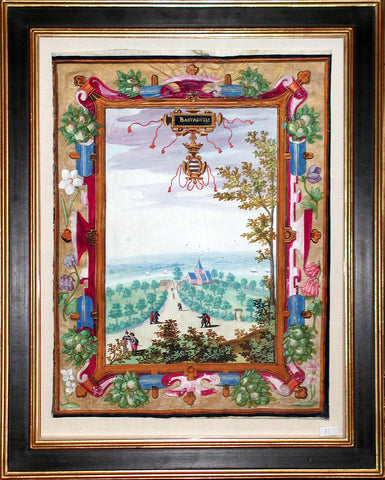
This evocative watercolor by William Henry Jackson depicts a wagon train descending a hillside toward the vast western plains, conveying both the promise and uncertainty of the American frontier. In the foreground, a covered wagon, accompanied by settlers on foot and horseback, carefully follows a winding trail toward an expansive landscape of rivers, grasslands, and distant buttes. Jackson’s soft washes of blue, lavender, and green create an atmosphere of openness and possibility, while the sweeping sky emphasizes the immense scale of the country awaiting settlement. The composition invites the viewer to imagine the physical challenges and emotional resolve required of those who journeyed west in search of land, opportunity, and a new beginning.
The scene represents the great era of westward expansion during the mid-nineteenth century, when thousands of emigrants traveled the Oregon, California, Mormon, and Santa Fe Trails in covered wagons. Motivated by the promise of fertile farmland, economic opportunity, and the discovery of gold, families undertook journeys that often lasted several months across difficult and unfamiliar terrain. While these migrations became central to the American ideal of Manifest Destiny—the belief that the United States was destined to expand across the continent—they also brought profound consequences for Indigenous peoples. As settlers occupied ancestral lands, Native American communities experienced displacement, broken treaties, conflict, and the destruction of traditional ways of life. Jackson’s peaceful depiction reflects the optimism many settlers associated with westward migration, yet it also serves as a reminder of the complex and often painful history that accompanied the nation’s expansion.
Painted in 1936, this watercolor is particularly significant because it was created decades after the frontier era had ended. Rather than serving as a firsthand record of an active wagon migration, it is a reflective work by an artist looking back on a defining period in American history. Jackson’s inscription and delicate technique lend the painting the quality of a personal remembrance, preserving the spirit of a journey.
William Henry Jackson (1843–1942) was one of America’s most important photographers, painters, and explorers of the American West. Best known for his photographs taken during government surveys in the 1860s and 1870s, Jackson documented landscapes that were largely unknown to the eastern United States. His remarkable images of the Yellowstone region played a pivotal role in convincing Congress to establish Yellowstone as the nation’s first national park in 1872. Throughout his long career, Jackson traveled extensively across the western territories, recording dramatic scenery, railroad expansion, frontier settlements, and Native American life. In addition to photography, he was an accomplished water-colorist whose paintings combined firsthand observation with a nostalgic appreciation for the disappearing frontier.
We Also Recommend