
William Henry Jackson (1843-1942), Mt. Nebo West from Near Nephi
William Henry Jackson (1843-1942)
Mt. Nebo West from Near Nephi
Ink and monochrome wash on paper mounted to card
7 1/4 × 10 3/4 inches
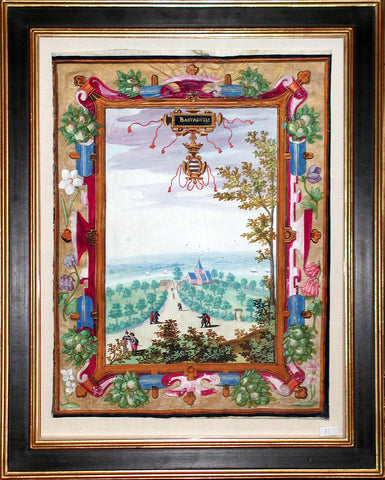
Executed in ink and monochrome wash, Mt. Nebo West from Near Nephi presents a sweeping view of one of central Utah’s most prominent mountain peaks. Seen from the vicinity of Nephi, Jackson depicts Mount Nebo rising dramatically above the surrounding valleys, its rugged slopes and layered ridgelines rendered with delicate washes that capture the changing effects of light. The restrained monochromatic palette emphasizes the mountain’s imposing mass while conveying the clarity and openness of the high-desert landscape.
Jackson’s drawing reflects the artist’s lifelong commitment to topographical accuracy. Fine pen work articulates the contours of the foothills and rocky escarpments, while subtle tonal gradations create a convincing sense of depth and distance. The broad foreground gives way to the towering summit, inviting the viewer to experience the immense scale of the Wasatch Plateau and the isolation of the western frontier. Although modest in size, the drawing possesses the panoramic quality that distinguishes many of Jackson’s western landscapes.
Mount Nebo, the highest peak in Utah’s Wasatch Range at more than 11,900 feet, served as an important geographic landmark for explorers, surveyors, and early settlers traveling through central Utah. Visible for many miles across the Juab Valley, the mountain marked the transition between fertile agricultural settlements and the more rugged terrain beyond. During the decades following the arrival of Mormon pioneers in 1847, the region around Nephi became an important corridor connecting northern and southern Utah, and Jackson’s view records a landscape that was rapidly becoming integral to the development of the American West.
Jackson first traveled through Utah during the great government surveys of the late nineteenth century, producing photographs and sketches that remain among the most significant visual records of the region. This later drawing revisits a landscape that had long occupied an important place in his artistic memory, combining the precision of a survey artist with the sensitivity of a mature landscape painter. Rather than emphasizing human activity, Jackson allows the monumental character of Mount Nebo itself to dominate the composition, underscoring the enduring grandeur of the western landscape.
We Also Recommend