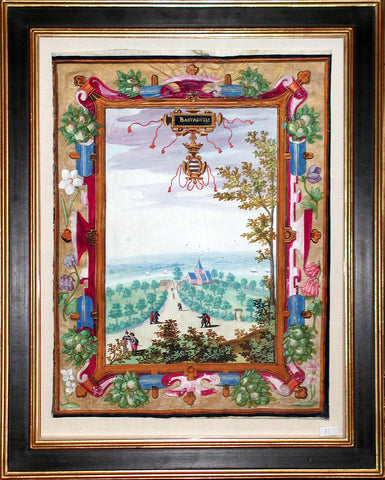

William Henry Jackson (1843-1942), Canyon Pack Mule Disaster
William Henry Jackson (1843-1942)
Canyon Pack Mule Disaster
Ink and monochrome wash on brown sketchbook leaf
Paper size: 7 3/4 × 5 in.
Frame size: 17 x 19 3/4 in.
Signed lower left.
This dramatic ink and monochrome wash by William Henry Jackson captures the inherent dangers of travel through the rugged mountain landscapes of the American West. Executed on a brown sketchbook leaf, the composition depicts a pack train negotiating a narrow trail carved into the face of a steep canyon wall. At the center of the scene, a heavily laden pack mule loses its footing and tumbles over the precipice, while its cargo breaks apart in midair. Above, the remaining animals hesitate along the exposed trail, and below, members of the expedition gather in alarm, gesturing toward the falling animal as others stand beside their mounts awaiting the outcome.
Jackson structures the composition around the dramatic vertical drop of the cliff, using the diagonal line of the trail to heighten the sense of movement and peril. Broad washes establish the massive rock faces, while fluid pen work defines the figures, pack animals, and sparse pines that cling to the canyon slopes. The restrained monochromatic palette emphasizes the stark geology and focuses attention on the unfolding accident, creating a vivid narrative within an otherwise quiet landscape.
The scene reflects the logistical challenges faced by survey parties, military expeditions, prospectors, and explorers who depended on pack animals to transport provisions and equipment through the mountainous West. Before the arrival of railroads and modern roads, narrow cliffside trails were often the only routes through remote canyons, and accidents involving pack mules or horses could result in the loss of valuable supplies—or even human life. Jackson witnessed such expeditions firsthand during his years accompanying government geological surveys under Ferdinand V. Hayden in the late 1860s and early 1870s. His sketches frequently recorded not only the grandeur of the western landscape but also the everyday hardships and hazards that accompanied exploration.
Unlike Jackson’s panoramic views of celebrated landmarks, this intimate narrative focuses on the human drama of western travel. The precarious trail, the startled animals, and the reactions of the men below convey both the unpredictability of frontier expeditions and the resilience required to traverse some of the continent’s most unforgiving terrain. Signed at the lower left, the drawing exemplifies Jackson’s remarkable ability to combine documentary observation with lively storytelling, transforming an ordinary mishap into a compelling record of the realities of exploration in the nineteenth-century American West.
We Also Recommend