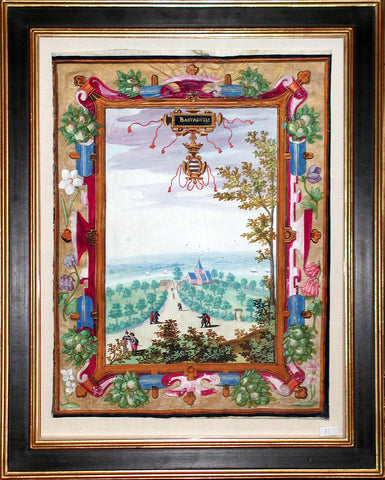

Thomas Moran (American, 1837-1926), Wissahickon River Falls
Thomas Moran (American, 1837-1926)
"Wissahickon River Falls"
Watercolor on paper laid on board
signed lower right, framing label and note on reverse of frame, conservation notes on backing, framed.
Paper size: 25 1/4 x 18 1/8 in.
Frame size: 32 1/2 x 26 1/4 x 3 in.
Original carved gold-leaf frame.
Thomas Moran (1837–1926) was one of America’s most celebrated landscape painters, renowned for his dramatic depictions of the American West that helped shape public perceptions of places such as Yellowstone and the Grand Canyon. Born in Bolton, England, Moran immigrated with his family to Philadelphia in 1844 and grew up in the city’s Kensington neighborhood. As a teenager, he apprenticed with the wood-engraving firm Scattergood & Telfer, but soon turned his attention to painting, studying under local artists and developing a lifelong admiration for the work of the British painter J. M. W. Turner.
Before achieving national fame through his western landscapes, Moran found inspiration much closer to home in the wooded valleys and streams of southeastern Pennsylvania. During the 1850s and 1860s, he spent considerable time sketching and painting along the Wissahickon Creek, a picturesque tributary of the Schuylkill River northwest of Philadelphia. The rugged gorge, dense forests, and winding waterway became some of his earliest and most important subjects. "Wissahickon River Falls" demonstrates his ability to capture the region’s rich seasonal colors and atmospheric effects. Moran himself described the inspiration for one of these paintings as being “incited by a most glorious Autumn.”
The Wissahickon Valley was a significant artistic training ground for Moran. The area’s natural beauty attracted many nineteenth-century artists, writers, and naturalists, and Moran returned to it repeatedly throughout his early career. He included views of the Wissahickon in a portfolio of lithographs produced in Philadelphia during the 1860s. The experience of observing and recording the creek’s landscapes helped refine the techniques of color, light, and atmosphere that would later distinguish his monumental western paintings.
Moran’s career reached its height after his participation in western expeditions during the 1870s. His paintings of Yellowstone were instrumental in building public support for the preservation of the region and creation of our National Park System. His paintings and lithographs of the Grand Canyon became icons of American art. Yet despite his association with the West, his artistic roots remained firmly connected to Pennsylvania and the landscapes around Philadelphia. The Wissahickon, where he developed his vision as a young artist, played a crucial role in shaping the painter who would become known as one of America’s greatest interpreters of nature.
We Also Recommend