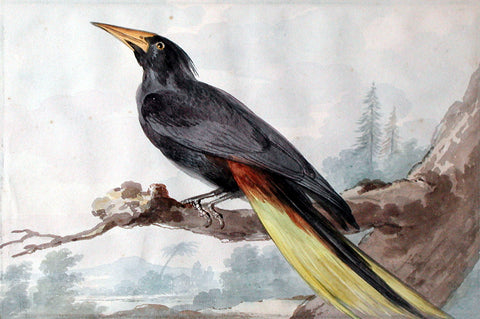

Louis Agassiz Fuertes (American, 1874 - 1927), Peregrine Falcon in Flight
Louis Agassiz Fuertes (American, 1874 - 1927)
Peregrine Falcon in Flight.
Watercolor and gouache on paper.
Signed lower left: "Louis Agassiz Fuertes".
Inscribed lower left: "To Harry Ferguson Recalling Many Happy Days at Fishers Island With a Merry Christmas from Louis Agassiz Fuertes’ Dated ‘Dec 25 1923".
1923.
Sheet size: 21 x 14 in.
Frame size: 31 x 24 in.
By 1923, the year this watercolor was executed, Louis Agassiz Fuertes stood at the height of his powers and his profession. He had recently been appointed a resident lecturer in ornithology at Cornell University, his alma mater, and was widely regarded as the most accomplished American bird artist of his generation. As early as 1897, when Fuertes was still a senior at Cornell, Elliott Coues, the dean of American ornithologists, had declared in The Osprey: “I say deliberately, with a full sense of the weight of my words, that there is now no one who can draw and paint birds so well as Mr. Fuertes; and I do not forget Audubon himself when I add that America has not before produced an ornithological artist of equal possibilities.”¹ The judgment proved prescient. By the third decade of the twentieth century, Fuertes had effectively displaced Audubon as the standard against which American ornithological illustration was measured.
The present watercolor exemplifies the qualities that earned that reputation. A peregrine falcon (Falco peregrinus) is shown in mid-flight, beak parted as if in mid-call, talons held tight against the body. The crisply barred underparts, slate-blue dorsal plumage, and characteristic dark hood and malar stripe are rendered with the anatomical precision Fuertes derived from years of fieldwork and specimen study, while the canted wings and slight turn of the head impart the sense of arrested motion that distinguishes his work from the static specimen portraits of his predecessors. Set against a warm, neutral ground that throws the figure into high relief, the composition focuses the eye on plumage and posture rather than on incidental setting.
The choice of subject was not incidental. Fuertes held a particular fascination with raptors, both as scientific subjects and as cultural emblems, and at a time when American birds of prey were broadly regarded as vermin, he was among their most articulate defenders. The December 1920 issue of National Geographic Magazine had carried two of his essays, “Falconry, the Sport of Kings” and “American Birds of Prey: A Review of Their Value,” illustrated with twelve full-page color plates from his own hand.² The peregrine, the falconer’s bird par excellence, would have carried particular resonance for both artist and recipient.
The watercolor was presented as a Christmas gift in 1923 to Henry “Harry” L. Ferguson, the artist’s close friend and frequent hunting companion. After H. L. Ferguson’s death in 1959, the work descended to his son, Charles “Charlie” Ferguson, in whose possession it remained until his death in 2018, when it was acquired by Arader Galleries.
Henry L. Ferguson was the son of one of the principal owners of Fishers Island, off the eastern end of Long Island, New York, and served for more than forty years as president of Fishers Island Farms. Yet his deepest interests lay outside the business of island development. A devoted amateur ornithologist, he collected and studied the bird life of Fishers Island throughout his life, and, as a self-taught archaeologist, he devoted years to documenting Native American artifacts found along the island’s shores.
Notes:
1. Elliott Coues, profile of Louis Agassiz Fuertes, The Osprey 1 (1897), as quoted in Robert McCracken Peck, A Celebration of Birds: The Life and Art of Louis Agassiz Fuertes (New York: Walker, 1982).
2. Louis Agassiz Fuertes, “Falconry, the Sport of Kings,” National Geographic Magazine 38, no. 6 (December 1920): 429-460; the companion essay “American Birds of Prey: A Review of Their Value” appears in the same issue.
Louis Agassiz Fuertes (American, 1874-1927)
Louis Agassiz Fuertes was the most widely acclaimed American ornithological artist of his time. Born in Ithaca, New York, Fuertes began drawing birds at an early age, inspired by Audubon's Birds of America. By the time he was seventeen, his illustrations had qualified him as an associate member of the American Ornithologists' Union. Fuertes quickly became associated with leading ornithological scientists and artists, and he received professional commissions while still an undergraduate at Cornell.
Fuertes went on to produce a vast body of work for an extensive range of projects. His paintings and drawings invariably convey the artist's meticulous study of his subjects' form and behavior. His diligence, precision, and skill in draftsmanship produced some of the most animated and engaging bird illustrations of the twentieth century. Fuertes was determined to study and draw birds as they behaved in their natural habitats, unlike his predecessors, including Audubon, who took the easier route of drawing from stuffed specimens. As a result of this scrupulous and sensitive study of living birds, Fuertes' works are characterized by much greater accuracy and a sense of vitality. Perhaps more than any of the other great bird artists, Fuertes' birds are always full of life. In the book "A Celebration of Birds: The Life and Art of Louis Agassiz Fuertes," the noted specialist on ornithological art Roger Tory Peterson notes that even today, "most bird painters are still influenced directly or indirectly by Fuertes..."
Fuertes traveled widely to broaden his knowledge of birds and their habitats. In 1899, for example, he accompanied the Harriman Expedition to Alaska, a group that traveled up the coast as far as Plover Bay in Siberia. Sponsored by the railroad and mining magnate Edward Harriman, the elaborately outfitted expedition included well-known scientists such as John Burroughs and John Muir, landscape artists Frederick Dellenbaugh and Robert Swain Gifford, and photographer Edward Curtis.
By that time, Fuertes has widely acclaimed himself, his illustrations have been disseminated in several publications. Yet his original watercolors, the most compelling testaments to this great bird artist's unparalleled abilities, are quite rare.
Please feel free to contact us with questions by phone at 215.735.8811,
or by email at loricohen@aradergalleries.
We Also Recommend