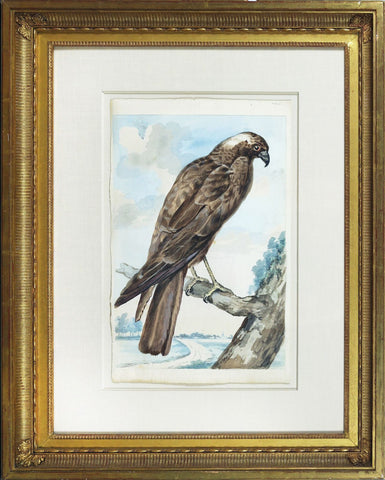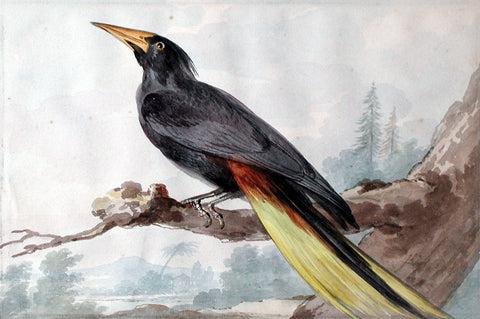

Joseph Wolf (German, 1820-1899), Saker Falcon; Falco sacer; Falco cherrug Gray
The saker breeds from central Europe and the Balkans across the Eurasian steppe to Mongolia and western China and winters south to the Middle East, northeast Africa, and northern India. Gould published it as Falco sacer; the name now in use, Falco cherrug, was given by J. E. Gray in 1834, and the confusion of names was itself a subject of Gould’s text (see below). The common name derives from the Arabic ṣaqr, “falcon,” and has been used in Europe since the thirteenth century. The bird is Mongolia's national bird, is identified in Hungary with the legendary turul, and remains the emblem of Arab falconry. Classified today as Endangered, it is one of the most closely watched birds of prey in the world.
In the 1860s, the saker was of interest on several fronts. Falconry was enjoying a revival among British sportsmen, and the bird’s use by the Bedouin and by the falconers of India and Central Asia was a recurring theme in travelers’ accounts. Ornithologically, it sat at the center of a tangle of names and supposed species that the new generation of field collectors in the Danube basin, the Levant, and India was beginning to unravel. Wolf knew falcons better than any artist of his time: his first major commission, in Leiden, had been the plates of Schlegel and Verster de Wulverhorst’s Traité de fauconnerie (Treatise on Falconry), in which the saker also appears.
This is Wolf’s finished design for the saker plate in The Birds of Asia, issued in April 1868 and lithographed by Henry Constantine Richter. An adult female, rendered at somewhat less than life size, stands on a lichened branch above a willow, gripping a green lizard, while a young bird in streaked brown plumage perches behind her. The pencil note “1.5a” in the lower margin corresponds to the plate’s place in the first volume of the work. Gould’s text records that “the Plate represents a female, from the Collection of Lord Lilford, somewhat less than the natural size, and a young bird in the distance,” which gives this sheet an unusually close link to its first owner: Lilford lent the specimen from which it was drawn and later acquired the drawing itself.
The handling shows Wolf at his most exacting. The pale, finely streaked head and breast are built up in bodycolor, the dark mantle in layered washes with each feather edged in warm brown, and the eye and cere are glazed with gum arabic to give them depth. Wolf’s oil of two sakers painted four years earlier (AP00715) uses the same contrast between adult and young and the same lizard, and the two works are best seen together.
Thomas Littleton Powys, 4th Baron Lilford, was one of the founders of the British Ornithologists’ Union in 1858 and served as president from 1867 until his death; he kept celebrated aviaries of living birds, including falcons, at Lilford Hall in Northamptonshire. Frederick DuCane Godman, coauthor with Osbert Salvin of the Biologia Centrali-Americana (Biology of Central America, 1879–1915), was among the great natural history collectors of the age. Drawings with this pairing of names form a small and coherent group that rarely appears on the market.
Gould’s text opens with a frank admission of taxonomic difficulty:
I am unacquainted with any species of Falcon the synonymy of which is in such a state of confusion as that of the present bird, familiarly known to most living ornithologists as the Saker.
He defers on matters of falconry to his friend Schlegel’s Traité de fauconnerie and gathers firsthand accounts from correspondents. Canon H. B. Tristram, traveling in Palestine, reported that “the Sheikhs of the Beni Sakk’r (sons of the Falcon) make it a point of distinction to possess several of these birds trained for the chase of the gazelle.” Most memorable is the account by W. H. Simpson, first printed in The Ibis in 1860, of finding a nest on an island in the Danube. Having shot the female, Simpson watched the male:
The male bird … was shortly afterwards observed sitting utterly motionless on the top of a dead tree, with his head turned over his shoulder; he seemed so mournfully conscious of the catastrophe which had befallen his family that I felt utterly ashamed at having added murder to robbery in my desire to possess myself of, as I supposed, an unknown bird.
JOSEPH WOLF (GERMAN, 1820-1899)
Sir Edwin Landseer described Joseph Wolf as “...without exception the best all-round animal painter who ever lived.” Born and educated in Prussia, Wolf left home at the age of 16 and apprenticed himself to the lithographic firm of Gebruder Becker in Coblenz, where he first met his future patron Hermann Schlegel, then the assistant keeper at the museum in Leyden and a prolific author of ornithological works. After brief spells in Frankfurt and Darmstadt, Wolf went to Holland and settled in Leyden in 1840; he was soon at work on the illustrations for Traite de Fauconnerie by Schlegel and Wulverhorst. Working on this book on falconry, Wolf became an expert at portraying birds of prey, a flawless skill of representation that is in full evidence in his watercolors.
After developing contact with John Gould, Wolf established himself in London in 1848, where he exhibited at the Royal Academy, met Edwin Landseer and other animal artists, and won the patronage of discerning collectors like the Duke of Argyll and Lord Derby. He quickly became the foremost animal illustrator in Britain. Wolf had a long and productive relationship with Gould, contributing plates to The Birds of Asia and The Birds of Great Britain, and Gould became a frequent visitor to Wolf’s studio. The rapidity of the growth of his reputation was due, according to his biographer A.H. Palmer, to his power “of revivifying a dried skin and not merely revivifying, but showing the most characteristic and beautiful attitude and expression of the living bird or animal.” However, Wolf did not wish to be categorized as a scientific illustrator, preferring to create complete and naturalistic compositions which conveyed a sense of drama and mystery. Rather than show his subjects isolated from their environment, he integrated them into a natural setting and portrayed them involved in dramatic action. This combination of animation and beauty characterizes Wolf’s watercolors.
In 1852, the British Zoological Society commissioned Wolf to complete several watercolors for its Zoological Sketches published in parts between 1856 and 1867. P.L. Sclater, the secretary of the society, noted in the publication’s preface, “the Council was fortunate enough to secure the services of Mr Joseph Wolf, who may be fairly said to stand alone in intimate knowledge of the habits and forms of Mammals and Birds.” By this stage in his career, Wolf’s works were in considerable demand both in their own right and as illustrations to books and journals. From 1859 to 1869 he was the regular artist for Ibis, the journal of the Zoological Society, and his work was also reproduced in the Illustrated London News, Once a Week, The Leisure Hour, The Sunday at Home, and The Graphic. Unfortunately, during the 1870s, Wolf was increasingly hindered by the onset of chronic rheumatism, which gradually curtailed his work, but he lived on into his eightieth year and died in London surrounded by his pet birds and held in high popular esteem. More than three-quarters of a century later his plates are regarded as among the finest productions of the great period of the illustrated book, while his oil paintings, watercolors and drawings are prized by museums and collectors alike.
Please feel free to contact us with questions by phone at 215.735.8811,
or by email at loricohen@aradergalleries.
We Also Recommend