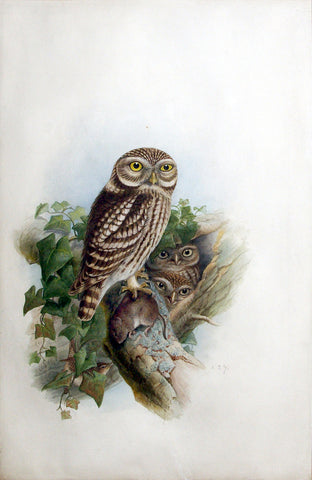

Joseph Wolf (German, 1820-1899), “Little Owl (Athene noctua)”
The Little Owl is native to continental Europe, North Africa, and western and central Asia, where it lives in open country with old trees, farmland, olive groves, and ruins. It is partly diurnal, and in classical Greece it was the bird of Athena, appearing on the silver coinage of Athens; hence its scientific name. Wolf could have studied it in the Rhineland of his youth, in the Netherlands, and in the captive birds kept in London.
When Gould published this plate, the Little Owl was not a British bird. It appeared only as a scarce and much-doubted vagrant to the southern counties, and Charles Waterton’s attempt to establish five birds brought from Rome at Walton Hall in Yorkshire in 1843 had failed. Gould accordingly wrote of it as a continental species whose British claims required scrutiny: “If this little Owl were indigenous to Britain instead of an accidental visitor, it would doubtless be a general favourite, for its economy is interesting, and its manners somewhat singular.”
The bird owes its present place in the English countryside to two landowners. Edmund Meade-Waldo released some forty owls at Stonewall Park in Kent between 1874 and 1880, where a pair bred in 1879; and Lord Lilford, this drawing’s first owner, bought owls in the London market and released them at Lilford Hall in Northamptonshire over many years. In 1889 one of his keepers found a Little Owl sitting in a hollow ash in the deer park, and the pair “brought off four young birds in the second week of June.” For a time the species was known in the Midlands as “Lilford’s owl,” and from these introductions it spread across most of England and Wales within fifty years. That a drawing of the species passed through Lilford’s hands gives it an unusual double interest, ornithological as well as artistic.
Few images in Victorian bird art hold the eye as directly as this one. The adult owl faces the viewer squarely, drawn to life size, its lemon-yellow irises set in a broad facial disc that Wolf has built up from thousands of fine hair strokes. It perches on a lichen-crusted bough at the mouth of a hollow trunk, one foot clamped over a freshly caught field vole. Behind and below, two nearly fledged owlets press together in the darkness of the nest hole, their gaze fixed on the same point as the adult’s. Ivy climbs the left of the composition, and at lower left a wren, worked more summarily, peers out from the leaves. The background is a wash of pale blue and gray, fading into untouched paper at every edge.
Wolf composed his subjects as episodes rather than specimens, and here he catches a domestic moment in the life of a hunting bird: the prey delivered, the young alert, the parent watchful. The three sets of eyes form a triangle that draws the viewer into the sheet. Technically the drawing is a fine demonstration of Wolf’s method with crisp graphite underdrawing visible at the contours of the bough and the ivy stems; watercolor is laid in thin washes, with the barred and spotted plumage stippled feather by feather in drier pigment; opaque bodycolor supplies the white spots of the breast and the highlights along the scapulars; and gum arabic is brushed over the eyes and the darkest passages of the wing to give them a wet, saturated depth. The vole is handled with equal care, its fur described in short directional strokes.
Gould conceived the plates of The Birds of Great Britain, supplied specimens and notes, and sometimes a rough sketch, but the finished design was the artist’s. Wolf’s drawings were then redrawn on stone, usually by Henry Constantine Richter or William Hart, printed, and colored by hand following a pattern plate approved by Gould. Sheets like this, in which the artist resolved the whole composition, occupy the pivotal place in that process. The pencil note “1.37” in the lower margin matches the plate’s position in the first volume of The Birds of Great Britain. Wolf worked freelance, kept his own studio, and made no secret of his reservations about Gould’s commercial instincts; Gould, for his part, considered him indispensable and reserved the raptors and owls for him whenever he could. Original Wolf drawings for Gould are held in quantity by only a handful of institutions, notably the Kenneth Spencer Research Library at the University of Kansas.
Gould’s letterpress closes by describing this composition and naming the prey:
The Plate represents the bird, of the natural size, with the nearly fledged young, from a drawing by Mr. Wolf. The little quadruped is the Short-tailed Field Mouse (Arvicola agrestis).
The “Short-tailed Field Mouse” is the field vole, now Microtus agrestis, the staple prey of the species across much of its range. Gould also noted the trade that complicated the British record: “specimens in the flesh are frequently sent to the London markets, and I fear often palmed upon our collectors as British killed.”
JOSEPH WOLF (GERMAN, 1820-1899)
Sir Edwin Landseer described Joseph Wolf as “...without exception the best all-round animal painter who ever lived.” Born and educated in Prussia, Wolf left home at the age of 16 and apprenticed himself to the lithographic firm of Gebruder Becker in Coblenz, where he first met his future patron Hermann Schlegel, then the assistant keeper at the museum in Leyden and a prolific author of ornithological works. After brief spells in Frankfurt and Darmstadt, Wolf went to Holland and settled in Leyden in 1840; he was soon at work on the illustrations for Traite de Fauconnerie by Schlegel and Wulverhorst. Working on this book on falconry, Wolf became an expert at portraying birds of prey, a flawless skill of representation that is in full evidence in his watercolors.
After developing contact with John Gould, Wolf established himself in London in 1848, where he exhibited at the Royal Academy, met Edwin Landseer and other animal artists, and won the patronage of discerning collectors like the Duke of Argyll and Lord Derby. He quickly became the foremost animal illustrator in Britain. Wolf had a long and productive relationship with Gould, contributing plates to The Birds of Asia and The Birds of Great Britain, and Gould became a frequent visitor to Wolf’s studio. The rapidity of the growth of his reputation was due, according to his biographer A.H. Palmer, to his power “of revivifying a dried skin and not merely revivifying, but showing the most characteristic and beautiful attitude and expression of the living bird or animal.” However, Wolf did not wish to be categorized as a scientific illustrator, preferring to create complete and naturalistic compositions which conveyed a sense of drama and mystery. Rather than show his subjects isolated from their environment, he integrated them into a natural setting and portrayed them involved in dramatic action. This combination of animation and beauty characterizes Wolf’s watercolors.
In 1852, the British Zoological Society commissioned Wolf to complete several watercolors for its Zoological Sketches published in parts between 1856 and 1867. P.L. Sclater, the secretary of the society, noted in the publication’s preface, “the Council was fortunate enough to secure the services of Mr Joseph Wolf, who may be fairly said to stand alone in intimate knowledge of the habits and forms of Mammals and Birds.” By this stage in his career, Wolf’s works were in considerable demand both in their own right and as illustrations to books and journals. From 1859 to 1869 he was the regular artist for Ibis, the journal of the Zoological Society, and his work was also reproduced in the Illustrated London News, Once a Week, The Leisure Hour, The Sunday at Home, and The Graphic. Unfortunately, during the 1870s, Wolf was increasingly hindered by the onset of chronic rheumatism, which gradually curtailed his work, but he lived on into his eightieth year and died in London surrounded by his pet birds and held in high popular esteem. More than three-quarters of a century later his plates are regarded as among the finest productions of the great period of the illustrated book, while his oil paintings, watercolors and drawings are prized by museums and collectors alike.
Please feel free to contact us with questions by phone at 215.735.8811,
or by email at loricohen@aradergalleries.
We Also Recommend