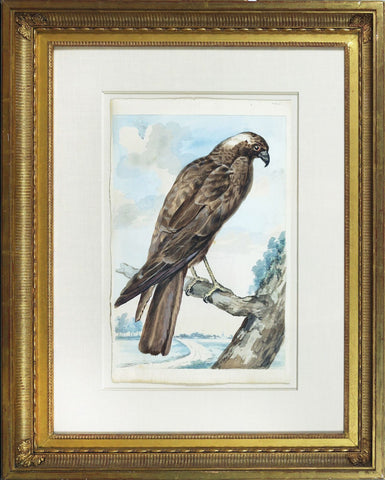
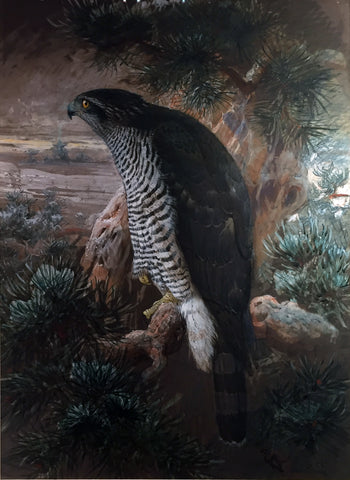

Joseph Wolf (German, 1820-1899), Goshawk (Adult Female). Accipiter gentilis (Northern Goshawk)
The goshawk is the great forest hawk of the Northern Hemisphere, breeding across the boreal and temperate woodlands of Europe, Asia, and North America. Females, far larger than males, take prey as large as hares and capercaillie. In Gould’s day the species bred regularly in France, Germany, and Scandinavia, which he called the bird’s great “nurseries,” but in Britain it had been reduced by gamekeeping to a rare and irregular breeder, chiefly in the old Caledonian pine forests of Speyside. It was effectively extinct as a British breeding bird by the 1880s and returned only in the twentieth century, largely from falconers’ escapes and releases.
Wolf knew the goshawk from his falconry work in Leiden, where it was a classic bird of the falconer’s mews, and from living birds; Gould’s text records Wolf as an informant on its behavior. The goshawk mattered to Victorians as a falconry bird, as a symbol of the wild northern forest, and as the arch-enemy of the game preserver, a combination that made its status in Britain a recurring topic in the sporting and ornithological press.
An adult female sits deep in the crown of a Scots pine, her body turned three-quarters away and her head in sharp profile so that the eye, a hot orange-yellow ringed in black, catches what little light there is. She is watching. Wolf has placed her where cover ends and open country begins. At left, beyond the last screen of needles, a pale plain recedes under a low and smoky sky, its middle distance broken by scattered conifers; at right, the pine closes in again, dense and unlit.
The slate gray of the mantle and folded wing is laid in broadly and then largely left alone, so that the bird’s mass reads as a single dark silhouette against the warmer browns of the trunk. Against that reserve, the barring of the underparts is drawn almost feather by feather in fine opaque strokes, each bar faintly irregular, following the rise of breast and flank. The undertail coverts are built up in bodycolor to a soft, woolly bloom, and the yellow legs and toes, closed on a lichened bough, supply the only note of fully saturated color. The pine needles are struck in with a dry brush over dark washes, giving them a bristling, backlit quality.
The sheet is related to the goshawk plate in the first volume of The Birds of Great Britain but differs from it in a telling way. The published plate shows the adult female with “a reduced figure of a young bird in the distance,” a device Gould favored because it allowed a single plate to show both plumages of a species in which they differ markedly. Here the young bird is absent, and an open landscape takes its place; comparison gives way to a study of a predator in its covert, with the far horizon supplying atmosphere and scale. The sheet alone cannot determine whether the change originated with Wolf or was imposed by Gould, though Palmer leaves no doubt that Wolf resented having others adjust his designs. Dated 1861, before the first part of The Birds of Great Britain was issued in 1862, the drawing belongs to the earliest work undertaken for the publication, among the raptors that open its first volume.
Two passages in Gould’s text bear directly on the drawing. Gould notes that the species breeds northward as far as the Scots fir extends, and his British localities are the old pine forests of Darnaway, Glenmore, Rothiemurchus, Abernethy, and Castle Grant. Wolf’s choice of Scots pine, and of conifers along the horizon, therefore, argues for where the bird belongs rather than for generic scenery. Gould also describes the goshawk sitting motionless for hours under the canopy, close to the trunk rather than on exposed branches, from which it scans its surroundings and steals upon its prey, and that is exactly how Wolf has painted her, half absorbed into shadow, with only the barred breast and the eye declaring her presence. Wolf’s original designs for Gould rarely come to market, and among them the raptors have always been the most sought after.
Gould’s letterpress opens with praise for “this truly noble species of Hawk” and records two remarkable birds he examined in the flesh: an immature female shot at Somerleyton, Suffolk, in January 1859, and an adult female from Normanby Park, Lincolnshire, taken in March 1864, so broad-shouldered that it reminded him of an eagle. He credits Wolf by name as a witness to the bird’s behavior:
Mr. Wolf tells me that he has known it, when pressed by hunger, dash out of its retreat and give chase to a Short-eared Owl.
The remark shows Wolf acting as one of Gould’s informants on behavior rather than merely the hand that drew the plate and helps explain why his birds of prey convince where so many Victorian raptors do not.
JOSEPH WOLF (GERMAN, 1820-1899)
Sir Edwin Landseer described Joseph Wolf as “...without exception the best all-round animal painter who ever lived.” Born and educated in Prussia, Wolf left home at the age of 16 and apprenticed himself to the lithographic firm of Gebruder Becker in Coblenz, where he first met his future patron Hermann Schlegel, then the assistant keeper at the museum in Leyden and a prolific author of ornithological works. After brief spells in Frankfurt and Darmstadt, Wolf went to Holland and settled in Leyden in 1840; he was soon at work on the illustrations for Traite de Fauconnerie by Schlegel and Wulverhorst. Working on this book on falconry, Wolf became an expert at portraying birds of prey, a flawless skill of representation that is in full evidence in his watercolors.
After developing contact with John Gould, Wolf established himself in London in 1848, where he exhibited at the Royal Academy, met Edwin Landseer and other animal artists, and won the patronage of discerning collectors like the Duke of Argyll and Lord Derby. He quickly became the foremost animal illustrator in Britain. Wolf had a long and productive relationship with Gould, contributing plates to The Birds of Asia and The Birds of Great Britain, and Gould became a frequent visitor to Wolf’s studio. The rapidity of the growth of his reputation was due, according to his biographer A.H. Palmer, to his power “of revivifying a dried skin and not merely revivifying, but showing the most characteristic and beautiful attitude and expression of the living bird or animal.” However, Wolf did not wish to be categorized as a scientific illustrator, preferring to create complete and naturalistic compositions which conveyed a sense of drama and mystery. Rather than show his subjects isolated from their environment, he integrated them into a natural setting and portrayed them involved in dramatic action. This combination of animation and beauty characterizes Wolf’s watercolors.
In 1852, the British Zoological Society commissioned Wolf to complete several watercolors for its Zoological Sketches published in parts between 1856 and 1867. P.L. Sclater, the secretary of the society, noted in the publication’s preface, “the Council was fortunate enough to secure the services of Mr Joseph Wolf, who may be fairly said to stand alone in intimate knowledge of the habits and forms of Mammals and Birds.” By this stage in his career, Wolf’s works were in considerable demand both in their own right and as illustrations to books and journals. From 1859 to 1869 he was the regular artist for Ibis, the journal of the Zoological Society, and his work was also reproduced in the Illustrated London News, Once a Week, The Leisure Hour, The Sunday at Home, and The Graphic. Unfortunately, during the 1870s, Wolf was increasingly hindered by the onset of chronic rheumatism, which gradually curtailed his work, but he lived on into his eightieth year and died in London surrounded by his pet birds and held in high popular esteem. More than three-quarters of a century later his plates are regarded as among the finest productions of the great period of the illustrated book, while his oil paintings, watercolors and drawings are prized by museums and collectors alike.
Please feel free to contact us with questions by phone at 215.735.8811,
or by email at loricohen@aradergalleries.
We Also Recommend