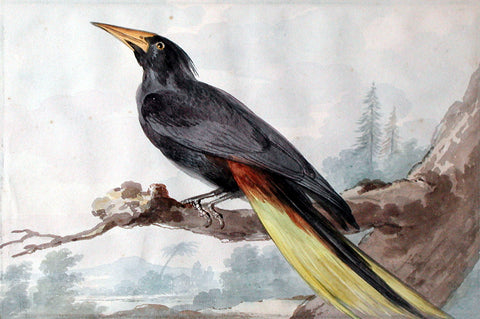
![John Gould (British, 1804-1881), [Bird Study]](http://aradergalleries.com/cdn/shop/files/AP00699_Gould_Study_of_Two_Warblers_among_Bracken_large.jpg?v=1785952183)
John Gould (British, 1804-1881), [Bird Study]
John Gould (British, 1804-1881)
[Study of Two Warblers among Bracken]
Graphite on light grey paper
Signed, dated, and inscribed left of image: J Gould the Bird Man / Decm 14 - 1860
Paper size: 20 1/2 x 13 in
Provenance: Compiled into an extensive album of nineteenth-century artists’ sketches by the young Miss Elizabeth Betts (d. 1940), whose parents, Mr. and Mrs. E. Ladd Betts, welcomed artists to their home at Preston Hall, Aylesford, Kent.
In the absence of color, the identification of this species cannot be certain, but the proportions and the bracken setting point most strongly to the Common Nightingale (Luscinia megarhynchos), based on the broad, slightly graduated rufous tail and upright singing posture the perched figure appears to record.
Graphite studies of this kind were routinely made from cabinet skins with habitat added from memory. Thus, the drawing is best understood as a presentation sheet rather than a sketch for a final composition. Typically, Gould’s preparatory material is rough with rapid, abbreviated pencil notations of pose and attitude, frequently annotated with instructions and handed directly to the artists who translated them onto stone, in this period principally Henry Constantine Richter, Joseph Wolf, and later William Hart. The present sheet is comparatively resolved, self-contained, and signed with a flourish for an audience, characteristics consistent with a drawing-room performance for a young hostess’s album rather than a step in the workshop process.
Dated December 1860, at the time of this drawing, Gould was closing out A Monograph of the Trochilidae, or Family of Humming-Birds (1849–1861), the project that had made him a public sensation after his hummingbird house at the 1851 Great Exhibition; he was simultaneously issuing parts of The Birds of Asia and the supplement to The Birds of Australia; and he was turning his attention homeward to The Birds of Great Britain, whose first part appeared in 1862 and which he came to regard as his finest achievement. The signature includes “The Bird Man,” the popular sobriquet given to Gould by the press and public, and here he adopts it in his own hand. It is a small but telling piece of evidence for how consciously Gould managed his public persona, an aspect of his career that later scholarship has taken up directly; Gordon Sauer titled his standard bibliographical study after the same phrase.
Edward Ladd Betts, the railway contractor and partner of Sir Samuel Morton Peto, built Preston Hall in the early 1850s and used it to entertain artists and public figures on a considerable scale. The family’s fortunes collapsed with the Overend, Gurney and Company crisis of 1866, after which the estate was sold. The album from which this sheet was gathered thus belongs to a narrow, well-defined window of hospitality in the early 1860s, which supports the December 1860 date and accounts for the drawing’s informal, sociable character.
JOHN GOULD (BRITISH, 1804-1881)
John Gould was without question the most prolific natural history artist of the nineteenth-century, and the only one to rival John James Audubon in ambition and quality. The nineteenth-century was a time of intense fascination with discoveries in natural history, especially regarding knowledge of the wildlife of exotic lands. Gould shared the romantic enthusiasm of his time for such subjects, as well as the popular impulse to catalogue exotic wildlife. He combined his passion for natural history with outstanding scientific, artistic, and entrepreneurial talents. Drawing on these abilities, he embarked on a series of projects that would eventually make him the leading publisher of ornithological illustrations in Victorian Britain. Gould’s unparalleled career spanned five decades, and he produced a monumental series of books of birds throughout the world.
From the time he took up taxidermy in his early teens, Gould was devoted to recording bird life, either as he observed it personally or as it was reported to him by other ornithologists. He procured the scientific information through extensive correspondence, travel, and field research. The preparatory drawings that he produced were passed on for completion to skilled illustrators, most notably his wife, Elizabeth, and Edward Lear. The plates which resulted from such partnerships were a splendid fusion of art and science, with a scope that remains unsurpassed. Stunning and at the same time highly accurate, Gould’s illustrations linked beauty to science, and science to beauty, in and an unprecedented manner.
Please feel free to contact us with questions by phone at 215.735.8811,
or by email at loricohen@aradergalleries.
We Also Recommend