Johannes Bronckhorst (Dutch, 1648-1727) An Asian Elephant, a Lion and a Civet Cat in a Landscape
Johannes Bronckhorst (Dutch, 1648-1727)
An Asian Elephant, a Lion and a Civet Cat in a Landscape
Pen and black ink and watercolor and gum arabic within brown ink framing lines
Signed lower right: J. B. fec.
Paper size: 13 5/8 x 10 3/4 in.
Frame size: 25 1/2 x 22 in.
Provenance: Pieter van den Brande or Johan Pieter van den Brande, Middleburg; by descent to E.C. Baron van Pallandt; his sale Amsterdam, Mak van Waay, 26 September 1972, lot 290; and Unicorno Collection.
Exhibitons: Amsterdam/Dordrecht 1994-1995, cat. no. 30.
Literature: Anne M. Zaal, “Herman Henstenburgh 1667-1726,” Dissertation (Vrije Universiteit,
Amsterdam, 1991), reproduced vol.1, fig.20; W. W. Robinson, Seventeenth-Century Dutch
Drawings: A Selection from the Maida and George Abrams Collection, Exh. Cat. (Amsterdam,
Rijksmuseum, Vienna, Graphische Sammlung Albertina, New York, Pierpont Morgan Library,
and Cambridge, Mass., Fogg Art Museum, 1991-1992), p 222, note 2.
#AP02568
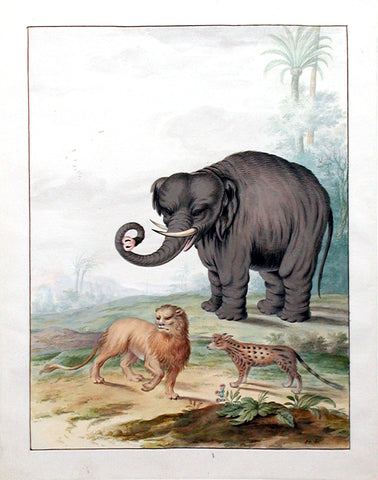
The three creatures depicted span three continents and represent the remarkable reach of Dutch global trade in the seventeenth century. Together they amount to a kind of painted cabinet of curiosities on paper, assembling the exotic and the wondrous in a single composed landscape.
The Asian elephant (Elephas maximus) dominates the composition, rendered with careful attention to its most distinctive features: the rounded back, the relatively small ears, and the two ivory tusks, which identify it as a male. Native to South and Southeast Asia, ranging from India and Sri Lanka to Sumatra and Borneo, the Asian elephant is the largest land animal on the continent. It is a creature of remarkable intelligence, known to use tools, exhibit mourning behavior, and demonstrate long-term memory. In early modern Europe, live elephants occasionally arrived as diplomatic gifts. One of the most celebrated was Hanno, the white elephant presented to Pope Leo X by King Manuel I of Portugal in 1514, which became the subject of portraits and poems across the continent. The curled trunk in Bronckhorst’s depiction suggests the animal may have been observed in motion or at a menagerie, where such creatures were occasionally housed by wealthy Dutch civic institutions and private collectors.
The lion (Panthera leo) in the foreground is depicted with a full mane, indicating it is an adult male. Lions are native primarily to sub-Saharan Africa, with a small relict population surviving today in the Gir Forest of Gujarat, India. By the seventeenth century, lions had already become fixtures of European royal menageries, and the Dutch stadtholders maintained their own collection of exotic animals at The Hague. The lion’s posture here is alert and forward-leaning, suggesting a degree of direct observation rather than pure dependence on earlier printed sources, though some stylization in the mane and facial features reflects the conventions of the period.
The smallest figure, the civet cat, is identifiable by its spotted coat and long body. This is most likely the common genet (Genetta genetta) or an African civet (Civettictis civetta), both of which were well known to European traders and naturalists. The African civet is native to the woodland and savanna regions of sub-Saharan Africa. It held particular commercial importance in early modern Europe because of a musky secretion, called civet, produced by glands near its tail. This substance was a prized ingredient in perfumery and was harvested from captive animals kept in special cages. Civets, therefore, occupied an unusual position in early modern culture: they were simultaneously objects of natural curiosity, economic commodities, and, as depicted here, subjects of artistic study.
That these three animals appear together in a single landscape is an interesting choice. No shared habitat could have contained a South Asian elephant, an African lion, and a civet in the wild. Their assembly on a single sheet is an act of artistic and intellectual ordering, akin to the encyclopedic impulse behind the natural history collections then flourishing across the Dutch Republic. In this sense, Bronckhorst’s drawing is not merely a record of three exotic animals. It is a reflection of a culture that believed the world’s wonders could be gathered, classified, and possessed through the act of looking.
This work has a distinguished provenance, having come from the Unicorno Collection, formed by Dutch collectors Saam and Lily Nijstad, and in the Van den Brande Collection in Middelburg; it is possible that the family commissioned or purchased this drawing directly from the artist. The significance and scope of the Unicorno Collection are recognized by the Dutch national art historical documentation agency (the Rijksbureau voor Kunsthistorische Documentatie), the Rembrandt House Museum, and the Dordrechts Museum, which have collaborated to research and document each drawing in this remarkable collection. Renowned experts in Dutch drawings, Charles Dumas and Robert-Jan te Rijdt, cataloged each unique watercolor and drawing.
Johannes Bronckhorst (Dutch, 1648-1727)
The second half of the seventeenth century witnessed an extraordinary expansion of European curiosity about the natural world. Propelled by the global commerce of the Dutch East India Company (VOC) and West India Company (WIC), merchants, naturalists, and regents assembled private cabinets of curiosity and outdoor menageries stocked with exotic specimens from Asia, Africa, and the Americas. Amsterdam and its prosperous satellite cities became centers of this collecting enthusiasm, and demand grew rapidly for artists capable of rendering rare birds and animals with both scientific fidelity and aesthetic refinement. Watercolor on vellum proved the medium of choice for such commissions, situating natural history illustration at the productive intersection of empirical inquiry and connoisseurship.
Johannes Bronckhorst was born in Leiden in 1648, the son of the painter Pieter van Bronckhorst. His early life was marked by hardship: the Dutch Golden Age biographer Arnold Houbraken recorded in De groote schouburgh der Nederlantsche konstschilders en schilderessen (The Great Theatre of Dutch and Flemish Painters and Paintresses) that Pieter died when Johannes was only thirteen, leaving the boy without a close family network.¹ Sent to the artistically vibrant city of Haarlem to work as a pastry baker in a cousin’s household, the young Bronckhorst was exposed, even if indirectly, to a city renowned for its still-life and naturalistic painting traditions. He eventually married and settled in Hoorn, the prosperous Zuiderzee port town, establishing his pastry trade around 1670 while continuing to draw with sustained dedication.
Houbraken noted that Bronckhorst received no formal artistic apprenticeship, learning instead through close observation of living and preserved specimens rather than from a master.² This self-taught foundation was central to his artistic identity, a fact celebrated by the poet-preacher Johannes Vollenhove in a commemorative verse devoted to his work: “Nor a master’s lesson was given here / Only Nature was his mistress.”³
Stylistically, Bronckhorst drew on the example of Pieter Holsteijn the Younger, who had refined a scientifically grounded tradition of bird portraiture characterized by precise draftsmanship and neutral grounds. Bronckhorst built on this foundation but departed from it in consequential ways: rather than isolating subjects against a plain white background, he placed birds and mammals within elaborate estate landscapes animated by classical architectural ruins and lush foliage, setting his subjects in dynamic, almost theatrical postures that suggested creatures caught mid-movement.
Bronckhorst worked primarily in watercolor on vellum or fine paper, a medium superbly suited to capturing the iridescent sheen of tropical plumage, the delicate articulation of talons and beaks, and the translucency of individual feathers. He depicted his subjects either singly or grouped several to a sheet, frequently combining birds and mammals from different continents within a single composition. His range encompassed exotic species such as parrots, birds of paradise, and toucans alongside European herons, raptors, and songbirds, each rendered with the structural specificity that satisfied a naturalist while the landscaped settings gratified a collector’s appetite for decoration. The juxtaposition of creatures from across the globe on a single sheet was not merely a compositional convenience; it gave visual form to the Dutch merchant’s ambition to comprehend and possess the entire natural world within the confines of a portfolio.
Bronckhorst’s clients were drawn principally from the prosperous merchant and regent classes of northern Holland, individuals who maintained menageries on their country estates and sought detailed pictorial records of their exotic acquisitions. His sheets served simultaneously as scientific documents and as objects of aesthetic contemplation, a dual function that made them particularly attractive to collectors who understood natural history as both a scholarly pursuit and a social distinction. The combination of empirical accuracy and decorative elegance addressed exactly the values of this audience, for whom a watercolor album of exotic birds demonstrated the same cosmopolitan reach as the spices and textiles filling their warehouses.
Contemporary recognition of his achievement was most fully articulated by Vollenhove, whose commemorative verse expressed astonishment at the lifelike conviction of the work. The poet marveled that an observer would instinctively cry out, “This is not an illusion, o no / Of course, the birds live here.”4 Vollenhove further celebrated the geographic scope of Bronckhorst’s natural history interests: “What diligence has gathered collected them / From all four of the parts of the world? / Because never bore a land and air / Such a variety of birds in flight.”5 He made the pointed claim that Bronckhorst’s watercolors possessed “a vigor that surpasses Oil paint,” a remarkable assertion in a culture that still accorded oil painting the highest prestige among the arts.6 Houbraken’s inclusion of Bronckhorst in his landmark biographical compendium confirmed his standing among the acknowledged masters of Dutch Golden Age art, despite his unconventional path to artistic achievement. Bronckhorst contributed to the next generation of practitioners by training Herman Henstenburgh, who carried the tradition of naturalistic watercolor animal painting into the eighteenth century. He continued to work in Hoorn until his death in 1727, leaving a body of work that eloquently testifies to the intersection of mercantile prosperity, natural curiosity, and artistic ambition that defined the Dutch Golden Age.
Notes
1. Arnold Houbraken, De groote schouburgh der Nederlantsche konstschilders en schilderessen (The Great Theatre of Dutch and Flemish Painters and Paintresses), 3 vols. (Amsterdam: de weduwe van Arnout Leers, 1718-1721).
2. Houbraken, De groote schouburgh.
3. Johannes Vollenhove, commemorative verse on Johannes Bronckhorst, in Dutch; translation cited from the original. Vollenhove (1631-1708) was a prominent Dutch Reformed preacher and poet whose verse tributes to artists and scholars were widely circulated in manuscript and print.
4. Vollenhove, commemorative verse.
5. Ibid.
6. Ibid.
We Also Recommend
![Anonymous, Le Lapin Domestique [Domestic Rabbit]](http://aradergalleries.com/cdn/shop/products/DSCN7726_large.jpg?v=1584634225)