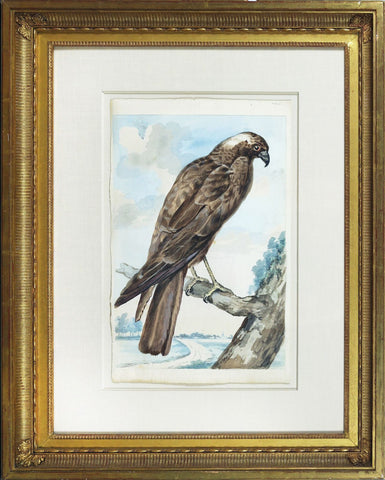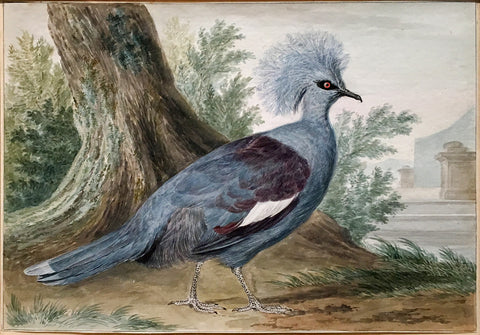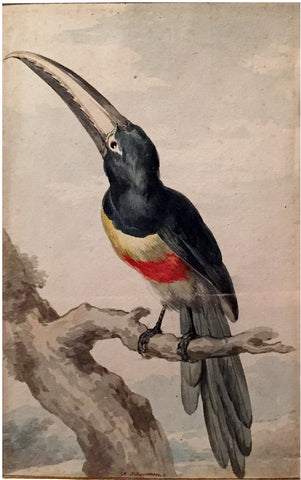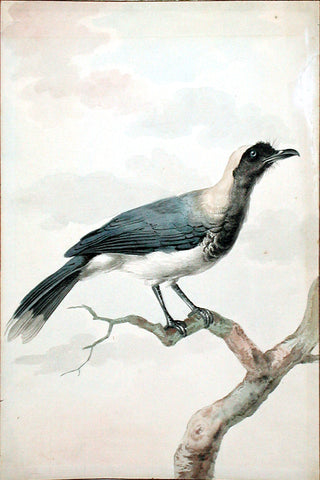
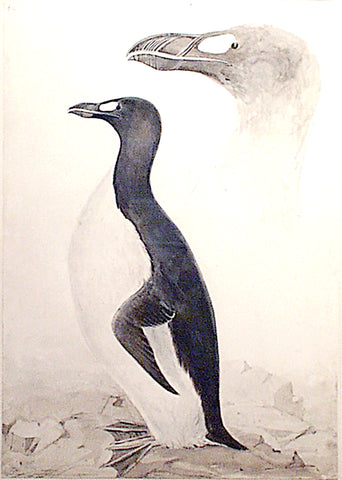
Edward Lear (British, 1812-1888) & Prideaux John Selby (British, 1788-1867), Great Auk
EDWARD LEAR (BRITISH, 1812–1888)
With Prideaux John Selby (British, 1788–1867)
Great Auk. Pinguinus impennis (Great Auk)
Prepared for pl. 82 of Selby, Illustrations of British Ornithology
Brown wash and ink over graphite on paper
Signed and dated lower left: “PJ Selby E Lear 1831”
Inscribed upper left: “82” (plate number)
1831
Sheet: 16 x 21 1/2 in.; Frame: 27 1/2 x 32 in.
Provenance: Collection of H. Bradley Martin
Literature: Vivien Noakes, Edward Lear, 1812–1888 (London: Royal Academy of Arts, 1985), 6; Christine E. Jackson, Bird Etchings: The Illustrators and Their Books, 1655–1855 (Ithaca, NY: Cornell University Press, 1985), 201–13; cf. Susan Chitty, That Singular Person Called Lear (London: Weidenfeld & Nicolson, 1988); Susan Hyman, Edward Lear’s Birds (London: Weidenfeld & Nicolson, 1980)
Inventory no. AP00211
The Great Auk was a large, flightless seabird of the North Atlantic, standing about thirty inches tall, black above and white below, with a massive grooved bill and a white patch before the eye. It bred in dense colonies on a handful of remote, low-lying islands, from Newfoundland’s Funk Island to Iceland, St. Kilda, and Orkney, and spent the rest of the year at sea. It was the original “penguin”: the name was given to it long before it was transferred to the unrelated birds of the Southern Hemisphere, and its scientific name Pinguinus preserves the connection.
When Lear and Selby made this drawing in 1831, the Great Auk was already on the brink of extinction, slaughtered for centuries by sailors and fishermen for food, oil, and feathers. The last British birds had been taken in Orkney in 1812–13, and in about 1840 one of the last birds seen in Britain was killed on St. Kilda by islanders who believed it to be a witch. The last known pair was killed on the island of Eldey, off Iceland, on June 3, 1844. No artist of Lear’s generation could have drawn the bird alive in Britain; Lear and Selby worked from preserved skins, which became objects of fierce competition among collectors once the species was gone. The drawing is thus a portrait of a bird that disappeared in the artist’s own lifetime, and one of the earliest images of it by a major artist.
Lear met the Northumberland naturalist Prideaux John Selby when he was about sixteen, before his years at Knowsley Hall and before his long and ultimately unhappy association with John Gould. Selby was then publishing his Illustrations of British Ornithology, etched by W. H. Lizars of Edinburgh and issued in parts between 1821 and 1834, with a later issue in 1841. Vivien Noakes suggests that “it is likely that Lear served an informal apprenticeship with Selby. If so, it was a fortunate training, for Selby demonstrated a bold and lively approach to his ornithological work which was ahead of his time, and which Lear was to develop with much skill in his later bird drawings." [1] Susan Chitty likewise credits Selby with advancing the young artist, observing that “under his influence Lear’s birds grew large and lively." [2]
Selby’s life-size folio transformed British ornithological illustration. As Christine Jackson writes, “Selby’s bird figures were the most accurate delineations of British birds to that date, and the liveliest. After so many books with small, stiff bird portraits, this new atlas with its life-size figures and more relaxed drawing was a great achievement in the long history of bird illustration." [3] Of the 277 surviving original drawings for the work, the Great Auk is the only one by Lear. Selby himself drew 217, his brother-in-law Robert Mitford fifty-five, and Sir William Jardine four.
A preliminary pencil drawing of the subject, unsigned, is in the Blacker-Wood Library at McGill University. The present wash drawing, developed from it, is signed by Lear and inscribed by Selby, who etched and signed the published plate. The etching enlarges the principal figure and omits the separate study of the head at upper right, which Lear drew with great care to record the deep grooves of the bill and the white patch before the eye.
Lear’s particular affinity for large, ungainly birds has often been remarked. Susan Hyman writes that “the large, monstrous, sinister and eccentric birds … are among the most remarkable bird drawings ever made, and it is evident that Lear endowed them with some measure of his own whimsy and intelligence, his energetic curiosity, his self-conscious clumsiness and his unselfconscious charm." [4] The upright, slightly awkward figure of the Great Auk, with its solemn profile, carries more than a hint of self-portraiture.
H. Bradley Martin (1906–1988) of New York formed one of the greatest private libraries of ornithology ever assembled, dispersed at Sotheby’s in 1989–90.
1. Vivien Noakes, Edward Lear, 1812–1888 (London: Royal Academy of Arts, 1985), 6.
2. Susan Chitty, That Singular Person Called Lear (London: Weidenfeld & Nicolson, 1988), 19–20.
3. Christine E. Jackson, Bird Etchings: The Illustrators and Their Books, 1655–1855 (Ithaca, NY: Cornell University Press, 1985), 212.
4. Susan Hyman, Edward Lear’s Birds (London: Weidenfeld & Nicolson, 1980), 45.
Lear was already drawing “for bread and cheese” by the time he was aged sixteen and soon developed into a serious “ornithological draughtsman” employed by the Zoological Society and then from 1832 to 1836 by the Earl of Derby, who kept a private menagerie at his estate, Knowsley Hall. He was the first major bird artist to draw birds from real live birds, instead of skins. Lear’s first publication, published when he was nineteen years old, was Illustrations of the Family of Psittacidae, or Parrots in 1830. One of the greatest ornithological artists of his era, he taught Elizabeth Gould while also contributing to John Gould’s works and was compared favorably with John James Audubon. Unfortunately his eyesight deteriorated too much to work with such precision on fine drawings and lithographic stones, thus he turned to landscape painting and travel.
In 1842, Lear began a journey into the Italian peninsula, traveling through the Lazio, Rome, Abruzzo, Molise, Apulia, Calabria, and Sicily. In personal notes, together with drawings, Lear gathered his impressions on the Italian way of life, folk traditions, and the beauty of the ancient monuments. He eventually settled in San Remo, on his beloved Mediterranean coast, in the 1870s, at a villa he named “Villa Tennyson.”
In 1846, Lear published A Book of Nonsense, a volume of limericks that went through three editions and helped popularize the form and the genre of literary nonsense. In 1871, he published Nonsense Songs, Stories, Botany and Alphabets, which included his most famous nonsense song, The Owl and the Pussycat, which he wrote for the children of his patron Edward Stanley, 13th Earl of Derby. Many other works followed.
Lear’s nonsense books were highly popular during his lifetime, but a rumor developed that “Edward Lear” was merely a pseudonym, and the books’ true author was the man to whom Lear had dedicated the works, his patron the Earl of Derby. Promoters of this rumor offered as evidence the facts that both men were named Edward, and that “Lear” is an anagram of “Earl.”
Lear’s nonsense works are distinguished by a facility of verbal invention and a poet’s delight in the sounds of words, both real and imaginary. A stuffed rhinoceros becomes a “diaphanous doorscraper.” A “blue Boss-Woss” plunges into “a perpendicular, spicular, orbicular, quadrangular, circular depth of soft mud.” His heroes are Quangle-Wangles, Pobbles, and Jumblies. One of his most famous verbal inventions, the phrase “runcible spoon,” occurs in the closing lines of The Owl and the Pussycat, and is now found in many English dictionaries.
Among other travels, he visited Greece and Egypt during 1848–49, and toured India during 1873–75, including a brief detour to Ceylon. While traveling he produced large quantities of colored wash drawings in a distinctive style, which he converted later in his studio into oil and watercolor paintings, as well as prints for his books. His landscape style often shows views with strong sunlight, with intense contrasts of color.
Throughout his life he continued to paint seriously. He had a lifelong ambition to illustrate Tennyson’s poems; near the end of his life a volume with a small number of illustrations was published.
After a long decline in his health, Lear died at his villa in 1888 of heart disease, from which he had suffered since at least 1870.
or by email at loricohen@aradergalleries.
We Also Recommend