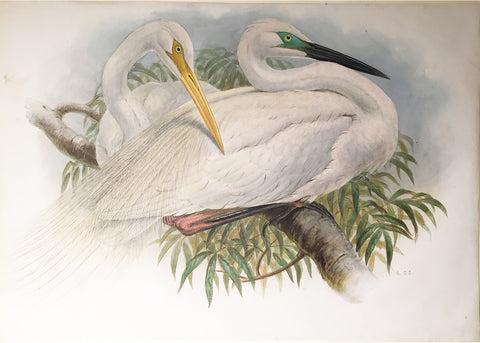
Henry Constantine Richter (British, 1821-1902), Great White Egret or White Heron (Herodias Alba)
The Great Egret is one of the world's most widely distributed herons, breeding in wetlands across southern and eastern Europe, Africa, Asia, Australasia, and the Americas. In Gould’s day it was a rare vagrant to Britain, and nearly every bird that arrived was shot; Gould himself lists the specimens killed in Yorkshire, Cambridgeshire, Oxfordshire, and on the Solway. Richter likely never saw one alive in England, and he would have drawn from skins and mounted specimens, aided by Gould’s field knowledge of the species in Australia.
The egret was about to become the emblem of a great Victorian controversy. The long, lacy breeding plumes, or “aigrettes,” that Richter has drawn so delicately on the back of the nearer bird were the most valuable feathers in the millinery trade, and the slaughter of egrets at their breeding colonies to supply them helped provoke the founding of the Society for the Protection of Birds (later the RSPB) in 1889 and, eventually, the Importation of Plumage (Prohibition) Act of 1921. The story has a happy ending because the Great Egret first bred in Britain in 2012, in Somerset, and is now a familiar sight in many English wetlands.
Two egrets stand on a curving branch amid a spray of willow leaves. The nearer bird, with its yellow bill and a cascade of fine plumes falling over its tail, turns its head back across its body; the farther bird stretches forward, its long black bill and the green facial skin of the breeding season sharply defined against the pale ground. Richter shows the two seasonal states of the bill that confused earlier naturalists, as Gould’s text explains, and he renders the white plumage with remarkable subtlety, modeling it in pale grays and blues and reserving the paper and touches of white chalk for the highlights.
The pencil note “4.22” in the lower margin matches the plate’s position in the fourth volume of The Birds of Great Britain. Large white birds are among the most difficult subjects in watercolor, and this sheet shows Richter’s command of tone at its finest.
Gould begins by staking the species’ claim to a place on the British list and noting its fate when it arrives:
There can be no doubt that the Herodias alba has just claims to a place in the avifauna of the British Islands.
As regards the habits and economy of the bird, there has of course been but little opportunity for becoming acquainted with them in this country, the individuals that stray here from the neighbouring continent being usually permitted but a brief sojourn, its attractive appearance soon causing it to become a victim to the gunner, and to be added to the rarities of some local museum or private collection.
He quotes T. C. Jerdon’s observation that Bonaparte had created confusion by separating the yellow-billed and black-billed egrets as different species, “not being aware that the colour of that organ changes with the season,” and closes: “The Plate represents both the summer and winter plumage, the figures being somewhat less than the natural size.”HENRY CONSTANTINE RICHTER (BRITISH, 1821-1902)
Among the most familiar and best-loved of John Gould's plates are those illustrated by Henry Richter, a young artist. He collaborated with him on over one thousand plates during forty years. Gould was the most prolific publisher of ornithological material during the golden age of Victorian illustration. He shared the romantic enthusiasm of his time for such subjects and the popular impulse to catalog exotic wildlife.
After the death of Elizabeth, John Gould's wife and artistic collaborator, Richter started to work with the master ornithologist. As both an artist and lithographer, he was a valuable assistant to Gould. Richter helped to complete the Birds of Australia, using Elizabeth's drawings, and then went on to be a significant force behind the completion of the Monograph of the Humming-birds.
Born in London in 1821, Henry Richter came from an artistic family. His grandfather had emigrated from Germany and carved out a career for himself as an engraver, artist, and scagliolist. Richter's father was also a noted painter and engraver, and he likely provided his children with artistic training at home. Henry's sister was a miniaturist.
Richter produced the following watercolors for Gould's Birds of Great Britain. Gould was incredibly proud of this great work, and partly because its subject was British, it was seen as the culmination of his genius. He described the Birds of Great Britain as a return to his old love. While the work exhibited similarities to his Birds of Europe, the latter publication's illustrations incorporate more nests, eggs, and young than the earlier work. The ornithologist-and the artists with whom he collaborated-took more of an interest in creating accurate, appropriate settings and included more plants and fully-delineated environments. More than his earlier productions, Gould created lavish scenes of action and interaction.
Gould's rightful pride in these illustrations was reflected in his preface explanation of their coloring: "…every sky with its varied tints and every feather of each bird were colored by hand; and when it is considered that nearly two hundred and eighty thousand illustrations in the present work have been so treated, it will most likely cause some astonishment to those who give the subject a thought." Gould's pride in The Birds of Great Britain was matched by its public success. The list of 468 subscribers included the nobility and scientific luminaries of Europe and America.
Please feel free to contact us with questions by phone at 215.735.8811,
or by email at loricohen@aradergalleries.
We Also Recommend