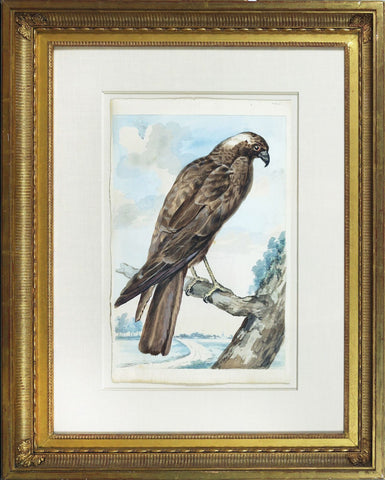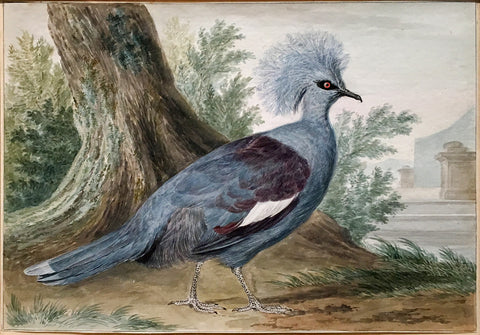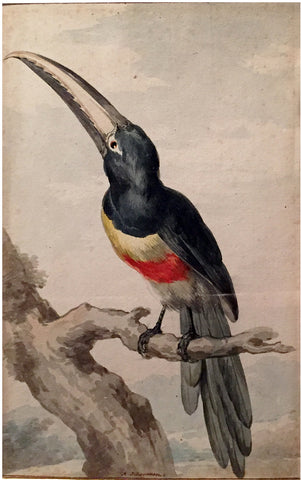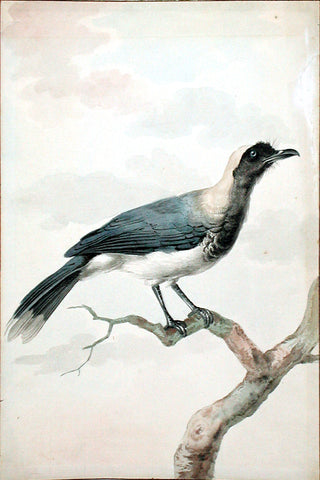
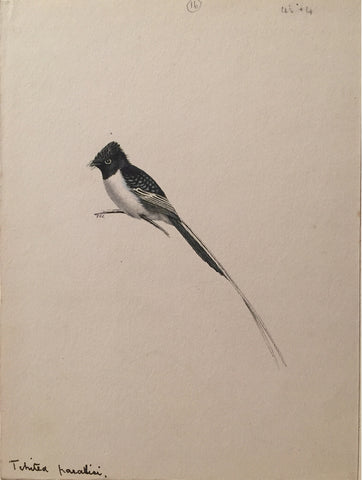
George Edward Lodge (British, 1860-1954), Tchitea Paradisi (Asian Paradise Flycatcher)
George Edward Lodge (British, 1860-1954)
Tchitea Paradisi (Asian Paradise Flycatcher)
Ink wash and gouache on paper
Titled and signed ‘G.E.L’
Paper size: 6 1/4” x 9”
# AP00267
Labeled with the old genus name Tchitrea, this is the Asian paradise flycatcher (Terpsiphone paradisi), a bird of forests and wooded gardens across the Indian subcontinent and much of Southeast Asia. Breeding males grow a pair of greatly elongated central tail feathers that trail far behind in flight, and older males often molt from a rich rufous into a striking silvery white.
The black, crested head and ribbon-like tail made the species a favorite subject of Indian and European painters alike. It is an active insect hunter, snapping up prey in mid-air with an audible click of the bill.
GEORGE EDWARD LODGE (BRITISH, 1860-1954)
George Edward Lodge was born on December 3, 1860 at Scrivelsby, Lincolnshire, the seventh of eleven children and fifth son of the Reverend Samuel Lodge (1829-1897), Canon of Lincoln Cathedral and rector of Scrivelsby. The ecclesiastical household at the family rectory was a deeply cultured one, in which the observation and description of the English countryside were part of daily life. Educated entirely at home, his earliest sketchbooks were filled with the game birds, waders, and raptors of the surrounding countryside.
Natural history was a shared pursuit among the Lodge siblings, and George’s lifelong dedication to ornithology grew from the example of his elder brother, Reginald Badham Lodge (1852-1937), who became one of the pioneering bird photographers in Britain. The two brothers often worked in tandem in the field, with Reginald’s photographs of nests and living birds providing George with invaluable scientific reference, while George’s painted interpretations brought artistic life to Reginald’s documentary images. This quietly collaborative sibling relationship, uniting the lens and the brush, is one of the most remarkable examples of family influence in late-Victorian natural history.
From boyhood, Lodge was an accomplished field naturalist. He taught himself taxidermy, mounting his first specimen, an owl, at the age of twelve, an experience that gave him an intimate understanding of avian musculature, feather structure, and posture that would distinguish his painted work for the next eight decades. He was also a falconer from his earliest days; a practice inherited through family connections to the sporting gentry of the shires and one that put living hawks and falcons quite literally in his hands throughout his life.
Lodge’s formal artistic training began at the Lincoln School of Art, where he won fourteen prizes for drawing before moving to London to serve an apprenticeship with an engraving firm. Contributing engraved work to the Badminton Library sporting volumes and to the ornithological publications of Henry Seebohm (1832-1895). However, watercolor and gouache became his signature media. Lodge worked fluently in both transparent watercolor and opaque body color (gouache), typically combining them on paper with ink under-drawing. He painted almost always from life, where he could, supplementing field studies with carefully prepared skins and mounted specimens. His knowledge of taxidermy and falconry gave his watercolors their remarkable sense of living weight.
Lodge traveled widely to gather material. He visited Sri Lanka (then Ceylon), Japan, the West Indies, the United States, and Scandinavia, but he was most at home in the Scottish Highlands and on the salmon rivers of Norway, both of which he visited annually for decades. In about 1920, Lodge settled at Camberley, Surrey, in a house on Upper Park Road that he renamed Hawk House, where he lived with his sister and niece and kept his studio, his taxidermy, and a working collection of hawks and falcons until his death at 93.
Lodge’s first important patron was Thomas Littleton Powys, 4th Baron Lilford (1833-1896), President of the British Ornithologists’ Union, who commissioned plates for his Notes on the Birds of Northamptonshire and Neighbourhood (1895). On that project Lodge worked alongside Archibald Thorburn (1860-1935), whose technique for painting plumage he admired above all others and with whom he formed a lifelong friendship. It was Thorburn who, having declined a commission from the New Zealand Government in the early 1910s to produce plates for a proposed replacement for Buller’s Birds of New Zealand, recommended Lodge in his place. Beginning in 1913, Lodge studied New Zealand bird skins in the Natural History Museum and other British collections and eventually delivered ninety watercolor plates to the Wildlife Service of the Department of Internal Affairs. Although the illness of the author prevented publication, the plates survive and constitute one of the great bodies of natural history watercolors produced in the twentieth century.
Lodge’s patrons and collaborators from across the scientific establishment were many. He illustrated the Rothschild’s Extinct Birds (1907), Beebe’s A Monograph of the Pheasants (1918-1922), Howard’s Territory in Bird Life (1920) and An Introduction to the Study of Bird Behaviour (1929), and painted plates for Baker’s The Birds of Hampshire and the Isle of Wight (1905), and Kirkman’s The British Bird Book. Through the Old Hawking Club, of which he was a long-standing member, Lodge also illustrated E. B. Michell’s celebrated articles on “Modern Falconry” in the English Illustrated Magazine in 1885-1886.
The culminating commission of Lodge’s life was David Armitage Bannerman’s twelve-volume The Birds of the British Isles (1953-1963), prepared under the Longmans “readership series” imprint. Lodge undertook this Herculean task in his ninth decade, producing 389 plates depicting 426 species. He began the work at the age of eighty-two and continued until his eyesight finally failed; the final volumes appeared after his death in 1954.
Please feel free to contact us with questions by phone at 215.735.8811,
or by email at loricohen@aradergalleries.
We Also Recommend