
Edward Lear (British, 1812-1888), Ye Owly Pusseycatte, a new Beast found in ye Island of New South Wales
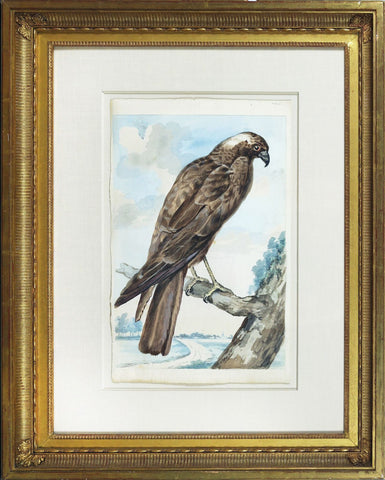
An imaginary creature: an owl with the striped, ringed tail of a cat, perched on a branch, smoking a long churchwarden pipe and wearing a broad hat trimmed with two peacock feathers, while a smiling moon looks on. The owl’s head and body are drawn with Lear’s naturalist’s eye, its streaked breast and barred plumage painted in warm browns, so the joke depends on the drawing's accuracy.
The inscription mocks the stream of extraordinary animals reported from Australia in the 1830s and 1840s, from the platypus to the lyrebird, and the scientific language in which they were announced. The reference to New South Wales suggests that the drawing dates from about the same period as Lear’s undated pen and ink sheet “Portraites of the inditchenous beestes of New Olland” in the Morgan Library and Museum, New York, which Vivien Noakes connected with John Gould’s expedition to Australia of 1838–40 to collect for The Birds of Australia. New Holland was the historical name for Australia. Lear had worked closely with Gould in the 1830s and teasing him about his discoveries would have been irresistible.
If, as seems likely, the drawing dates from the 1840s, it is probably the earliest in which Lear combined the owl and the cat, more than twenty years before he wrote “The Owl and the Pussy-cat” in 1867 for Janet Symonds, the small daughter of the writer John Addington Symonds. The poem was first published in 1870 and collected in Nonsense Songs, Stories, Botany and Alphabets (1871), where its closing lines introduced the “runcible spoon” to the English language. The smiling moon of the present drawing anticipates the moon by whose light the owl and the pussy-cat dance at the poem’s end.
The Drewitt family of Peppering House, near Arundel in Sussex, were among Lear’s oldest friends. His sister Sarah married Charles Street in 1822 and settled near Arundel, so Lear visited the district frequently from boyhood. Fanny Drewitt married George Coombe, probably in 1831, and the couple lived at Peppering. A group of Lear’s letters to the Coombes, rediscovered in the 1990s and sold at Christie’s on June 29, 1995, is now in the Frederick Warne Archive and provides a valuable record of Lear’s early life and movements.
Lear was already drawing “for bread and cheese” by the time he was aged sixteen and soon developed into a serious “ornithological draughtsman” employed by the Zoological Society and then from 1832 to 1836 by the Earl of Derby, who kept a private menagerie at his estate, Knowsley Hall. He was the first major bird artist to draw birds from real live birds, instead of skins. Lear’s first publication, published when he was nineteen years old, was Illustrations of the Family of Psittacidae, or Parrots in 1830. One of the greatest ornithological artists of his era, he taught Elizabeth Gould while also contributing to John Gould’s works and was compared favorably with John James Audubon. Unfortunately his eyesight deteriorated too much to work with such precision on fine drawings and lithographic stones, thus he turned to landscape painting and travel.
In 1842, Lear began a journey into the Italian peninsula, traveling through the Lazio, Rome, Abruzzo, Molise, Apulia, Calabria, and Sicily. In personal notes, together with drawings, Lear gathered his impressions on the Italian way of life, folk traditions, and the beauty of the ancient monuments. He eventually settled in San Remo, on his beloved Mediterranean coast, in the 1870s, at a villa he named “Villa Tennyson.”
In 1846, Lear published A Book of Nonsense, a volume of limericks that went through three editions and helped popularize the form and the genre of literary nonsense. In 1871, he published Nonsense Songs, Stories, Botany and Alphabets, which included his most famous nonsense song, The Owl and the Pussycat, which he wrote for the children of his patron Edward Stanley, 13th Earl of Derby. Many other works followed.
Lear’s nonsense books were highly popular during his lifetime, but a rumor developed that “Edward Lear” was merely a pseudonym, and the books’ true author was the man to whom Lear had dedicated the works, his patron the Earl of Derby. Promoters of this rumor offered as evidence the facts that both men were named Edward, and that “Lear” is an anagram of “Earl.”
Lear’s nonsense works are distinguished by a facility of verbal invention and a poet’s delight in the sounds of words, both real and imaginary. A stuffed rhinoceros becomes a “diaphanous doorscraper.” A “blue Boss-Woss” plunges into “a perpendicular, spicular, orbicular, quadrangular, circular depth of soft mud.” His heroes are Quangle-Wangles, Pobbles, and Jumblies. One of his most famous verbal inventions, the phrase “runcible spoon,” occurs in the closing lines of The Owl and the Pussycat, and is now found in many English dictionaries.
Among other travels, he visited Greece and Egypt during 1848–49, and toured India during 1873–75, including a brief detour to Ceylon. While traveling he produced large quantities of colored wash drawings in a distinctive style, which he converted later in his studio into oil and watercolor paintings, as well as prints for his books. His landscape style often shows views with strong sunlight, with intense contrasts of color.
Throughout his life he continued to paint seriously. He had a lifelong ambition to illustrate Tennyson’s poems; near the end of his life a volume with a small number of illustrations was published.
After a long decline in his health, Lear died at his villa in 1888 of heart disease, from which he had suffered since at least 1870.
or by email at loricohen@aradergalleries.
We Also Recommend