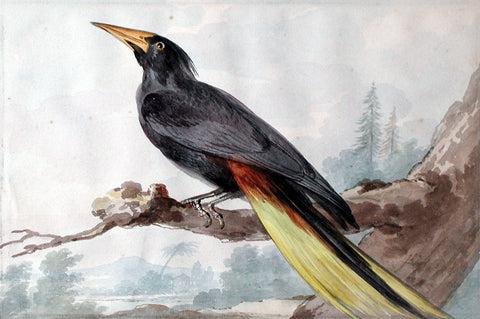

Edward Lear (British, 1812-1888), Study of a Paradise Shelduck
The Paradise Shelduck is a large, goose-like duck found only in New Zealand, where the Māori know it as pūtangitangi. It is one of the few ducks in which the female is the more conspicuous sex: she has a chestnut body and a striking white head, while the male is dark gray with a black head glossed with green. Pairs mate for life and call to one another constantly, the male with a deep zonk-zonk and the female with a shrill zeek. Unlike many native New Zealand birds, it has flourished as forests were cleared for pasture.
In the 1830s, New Zealand birds were rare in Europe. Only a handful of skins had arrived, chiefly from Cook's voyages and later naturalists, and the differences between the sexes were still confusing. The white-headed bird Lear has drawn is the female; his note “juv.” and the second inscription, which gives the name Casarka castanea that Eyton coined in 1838 for the related Australian Shelduck, both show how uncertain the identification of these birds remained.
The shelduck stands in profile on a pencil-indicated bank, its rich chestnut body, dark wings with white coverts and a green speculum, and white head set against the bare paper. Lear has given the plumage a remarkable softness through layered washes and has glazed the darkest feathers and the bill with gum arabic. The bird’s calm, upright stance, with the head held high, gives it the dignity that Lear brought to all his larger birds.
Thomas Campbell Eyton (1809–1880), a Shropshire landowner, naturalist, and friend and correspondent of Charles Darwin, published A Monograph on the Anatidae, or Duck Tribe in 1838. The plates, uncolored lithographs by George Scharf, include six engraved after studies by Lear. This drawing is among the last ornithological work Lear undertook before failing eyesight, and the pull of landscape led him to Rome in 1837.
Lear was already drawing “for bread and cheese” by the time he was aged sixteen and soon developed into a serious “ornithological draughtsman” employed by the Zoological Society and then from 1832 to 1836 by the Earl of Derby, who kept a private menagerie at his estate, Knowsley Hall. He was the first major bird artist to draw birds from real live birds, instead of skins. Lear’s first publication, published when he was nineteen years old, was Illustrations of the Family of Psittacidae, or Parrots in 1830. One of the greatest ornithological artists of his era, he taught Elizabeth Gould while also contributing to John Gould’s works and was compared favorably with John James Audubon. Unfortunately his eyesight deteriorated too much to work with such precision on fine drawings and lithographic stones, thus he turned to landscape painting and travel.
In 1842, Lear began a journey into the Italian peninsula, traveling through the Lazio, Rome, Abruzzo, Molise, Apulia, Calabria, and Sicily. In personal notes, together with drawings, Lear gathered his impressions on the Italian way of life, folk traditions, and the beauty of the ancient monuments. He eventually settled in San Remo, on his beloved Mediterranean coast, in the 1870s, at a villa he named “Villa Tennyson.”
In 1846, Lear published A Book of Nonsense, a volume of limericks that went through three editions and helped popularize the form and the genre of literary nonsense. In 1871, he published Nonsense Songs, Stories, Botany and Alphabets, which included his most famous nonsense song, The Owl and the Pussycat, which he wrote for the children of his patron Edward Stanley, 13th Earl of Derby. Many other works followed.
Lear’s nonsense books were highly popular during his lifetime, but a rumor developed that “Edward Lear” was merely a pseudonym, and the books’ true author was the man to whom Lear had dedicated the works, his patron the Earl of Derby. Promoters of this rumor offered as evidence the facts that both men were named Edward, and that “Lear” is an anagram of “Earl.”
Lear’s nonsense works are distinguished by a facility of verbal invention and a poet’s delight in the sounds of words, both real and imaginary. A stuffed rhinoceros becomes a “diaphanous doorscraper.” A “blue Boss-Woss” plunges into “a perpendicular, spicular, orbicular, quadrangular, circular depth of soft mud.” His heroes are Quangle-Wangles, Pobbles, and Jumblies. One of his most famous verbal inventions, the phrase “runcible spoon,” occurs in the closing lines of The Owl and the Pussycat, and is now found in many English dictionaries.
Among other travels, he visited Greece and Egypt during 1848–49, and toured India during 1873–75, including a brief detour to Ceylon. While traveling he produced large quantities of colored wash drawings in a distinctive style, which he converted later in his studio into oil and watercolor paintings, as well as prints for his books. His landscape style often shows views with strong sunlight, with intense contrasts of color.
Throughout his life he continued to paint seriously. He had a lifelong ambition to illustrate Tennyson’s poems; near the end of his life a volume with a small number of illustrations was published.
After a long decline in his health, Lear died at his villa in 1888 of heart disease, from which he had suffered since at least 1870.
or by email at loricohen@aradergalleries.
We Also Recommend