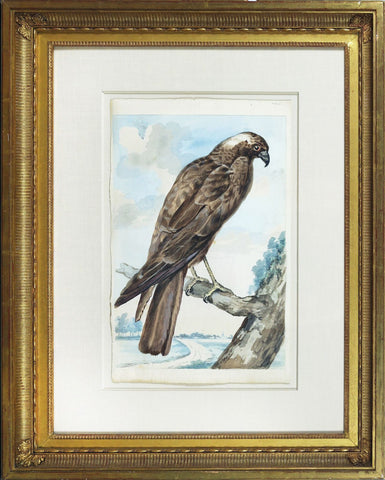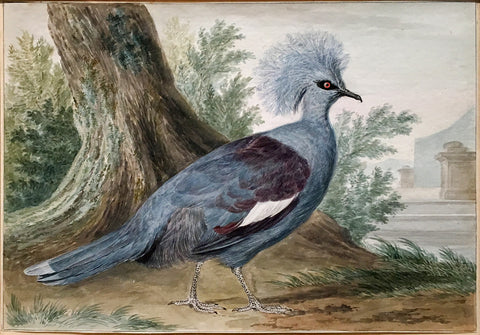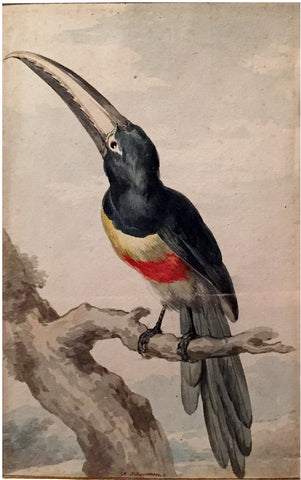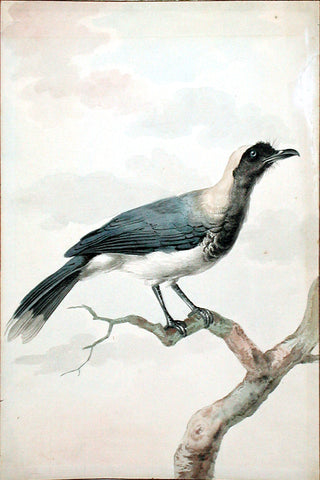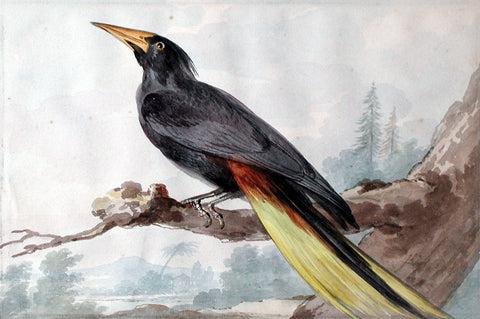

Edward Lear (British, 1812-1888), Study of a King Vulture
EDWARD LEAR (BRITISH, 1812–1888)
Study of a King Vulture. Sarcoramphus papa (King Vulture)
Drawn from life at the Surrey Zoological Gardens, April 1832
Watercolor over pencil heightened with bodycolor and gum arabic
Signed, dated, and inscribed lower left: “E Lear del.”; lower right: “April 1832” [written “Aril”]; lower center: “Sarcoramphus papa (Linn.)”; lower right: “Drawn from life at the / Surrey Zoological Gardens”
April 1832
Sheet: 10 x 12 3/4 in.; frame: 15 1/4 x 17 1/4 in.
Provenance: The ornithologist T. H. Newman; by whom given to the Zoological Society of London; sold through Wheldon and Wesley, 1992; private collection
Inventory no. AP00206
The King Vulture is a large New World vulture of tropical lowland forest and savanna, ranging from southern Mexico to northern Argentina. It is the most colorful of all vultures: its body is creamy white with black flight feathers and tail, its neck ruff is gray, and the bare skin of its head and neck is painted orange, red, purple, and yellow, with a fleshy orange caruncle over the bill. It has keen eyesight and, with its powerful bill, can tear open carcasses that smaller vultures cannot, which may explain its name: it often feeds first while others wait. Another explanation derives the name from Maya tradition, in which the bird figured as a king or a messenger between humans and the gods.
No King Vulture was seen wild in Britain, but the bird was a star attraction at London menageries. The Surrey Zoological Gardens in Walworth had opened in 1831, when the showman Edward Cross moved his animals there from the old Exeter Change menagerie in the Strand, and it rivaled the Zoological Society’s new gardens in Regent’s Park. For an artist like Lear, determined to draw from living animals rather than skins, these collections were indispensable.
Lear shows the vulture bending forward over the ground, wings folded and head lowered, as if inspecting something at its feet. The bare, wrinkled head is painted with brilliant precision in orange, red, and violet over gray, glazed with gum arabic to suggest its waxy texture, while the soft gray ruff and dark wing coverts are built up in transparent washes over careful pencil. A loosely brushed patch of ground and a pale hint of hills complete the setting.
The inscription “Drawn from life” is the key to the drawing’s significance. In April 1832, Lear was completing his Illustrations of the Family of Psittacidae, or Parrots (1830–32), the first British monograph devoted to a single family of birds and one drawn largely from living specimens in London collections. The insistence on working from life, unusual at the time, gave his birds a vitality and individuality that set them apart and brought him to the attention of Lord Stanley, the future 13th Earl of Derby, who engaged him that year to draw the animals at Knowsley Hall. This sheet captures the young artist at the moment he made his reputation.
Lear was already drawing “for bread and cheese” by the time he was aged sixteen and soon developed into a serious “ornithological draughtsman” employed by the Zoological Society and then from 1832 to 1836 by the Earl of Derby, who kept a private menagerie at his estate, Knowsley Hall. He was the first major bird artist to draw birds from real live birds, instead of skins. Lear’s first publication, published when he was nineteen years old, was Illustrations of the Family of Psittacidae, or Parrots in 1830. One of the greatest ornithological artists of his era, he taught Elizabeth Gould while also contributing to John Gould’s works and was compared favorably with John James Audubon. Unfortunately his eyesight deteriorated too much to work with such precision on fine drawings and lithographic stones, thus he turned to landscape painting and travel.
In 1842, Lear began a journey into the Italian peninsula, traveling through the Lazio, Rome, Abruzzo, Molise, Apulia, Calabria, and Sicily. In personal notes, together with drawings, Lear gathered his impressions on the Italian way of life, folk traditions, and the beauty of the ancient monuments. He eventually settled in San Remo, on his beloved Mediterranean coast, in the 1870s, at a villa he named “Villa Tennyson.”
In 1846, Lear published A Book of Nonsense, a volume of limericks that went through three editions and helped popularize the form and the genre of literary nonsense. In 1871, he published Nonsense Songs, Stories, Botany and Alphabets, which included his most famous nonsense song, The Owl and the Pussycat, which he wrote for the children of his patron Edward Stanley, 13th Earl of Derby. Many other works followed.
Lear’s nonsense books were highly popular during his lifetime, but a rumor developed that “Edward Lear” was merely a pseudonym, and the books’ true author was the man to whom Lear had dedicated the works, his patron the Earl of Derby. Promoters of this rumor offered as evidence the facts that both men were named Edward, and that “Lear” is an anagram of “Earl.”
Lear’s nonsense works are distinguished by a facility of verbal invention and a poet’s delight in the sounds of words, both real and imaginary. A stuffed rhinoceros becomes a “diaphanous doorscraper.” A “blue Boss-Woss” plunges into “a perpendicular, spicular, orbicular, quadrangular, circular depth of soft mud.” His heroes are Quangle-Wangles, Pobbles, and Jumblies. One of his most famous verbal inventions, the phrase “runcible spoon,” occurs in the closing lines of The Owl and the Pussycat, and is now found in many English dictionaries.
Among other travels, he visited Greece and Egypt during 1848–49, and toured India during 1873–75, including a brief detour to Ceylon. While traveling he produced large quantities of colored wash drawings in a distinctive style, which he converted later in his studio into oil and watercolor paintings, as well as prints for his books. His landscape style often shows views with strong sunlight, with intense contrasts of color.
Throughout his life he continued to paint seriously. He had a lifelong ambition to illustrate Tennyson’s poems; near the end of his life a volume with a small number of illustrations was published.
After a long decline in his health, Lear died at his villa in 1888 of heart disease, from which he had suffered since at least 1870.
or by email at loricohen@aradergalleries.
We Also Recommend