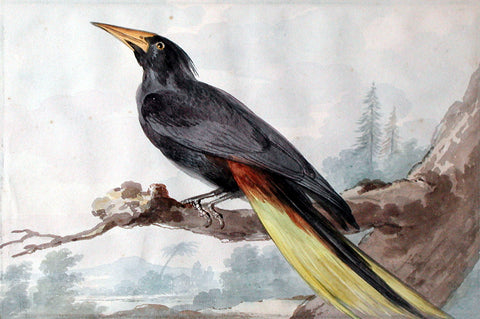
![VINCENZO LEONARDI (ITALIAN, 1590-1646), Western capercaillie, Tetrao urogalius [A Female Capercaille]](http://aradergalleries.com/cdn/shop/products/pozzoitalianschool_AFemaleCapercaille_large.jpg?v=1603127735)
![VINCENZO LEONARDI (ITALIAN, 1590-1646), Western capercaillie, Tetrao urogalius [A Female Capercaille]](http://aradergalleries.com/cdn/shop/files/pozzo_italian_school_A_Female_Capercaille_framed_large.jpg?v=1788202300)
VINCENZO LEONARDI (ITALIAN, 1590-1646), Western capercaillie, Tetrao urogalius [A Female Capercaille]
VINCENZO LEONARDI (ITALIAN, 1590-1646)
Western capercaillie, Tetrao urogalius [A Female Capercaille]
Watercolor and gouache over black chalk on paper watermarked with a crown surmounted by a star. Flaps at top and bottom pasted down on mount.
Mount sheet in the dal Pozzo collection: type D. Type A frame lines along the top and bottom.
Annotation ‘50’ lower right
Paper size: 18 1/2 x 22 1/2 in Frame size: 28 1/2 x 31 1/8 in
Provenance: Cassiano dal Pozzo, by descent to Cosimo Antonio dal Pozzo; Pope Clement XI;
Cardinal Alessandro Albani; King George III; Mendelson, London; James R. Herbert Boone;
Sotheby’s (New York), 16 September 1988, lot 163; W. Graham Arader III.
References: Vincenzo Leonardi, Western capercaillie, Tetrao urogallus, cat. no. 120 in McBurney and Violani, Birds, Other Animals and Natural Curiosities. The Paper Museum of Cassiano dal Pozzo, I, Royal Collection Trust, London 2017, p. 120.
The following watercolor originates from one of the most ambitious projects in the history of art collecting: Cassiano dal Pozzo’s Museo Cartaceo, or Paper Museum. Pozzo is celebrated today as one of the most important art patrons in seventeenth-century Italy. The principal scholars, antiquaries, scientists and collectors in Europe admired Cassiano above all for the extraordinarily important collection he began to assemble in the mid 1600s, the so-called Museo Cartaceo, or Paper Museum. This “museum” was to consist of drawings and prints of many relics of antiquity, and also of geological specimens, plants and animals from all over the world, and it was to be open for study to artists and scholars. For the extensive section on birds from which these striking watercolors originate, Cassiano wisely commissioned artworks from the best artists of his time, including Pietro da Cortona, Francesco Albani, Nicolas Poussin, Guido Reni, G.F. Romanelli, Andrea Sacchi, Paolo Ubaldini, and Vincenzo Leonardi.
Cassiano maintained connections with important patrons and friends, like the Medici family, who helped make their collections of bird specimens available for painterly use. Moreover, in 1603 he was admitted to Federico Cesi’s Accademia dei Lincei, a scientific society of which Galileo was also a member. This must have given special impetus to dal Pozzo’s collection of natural history drawings of which many of the bird studies were destined for reproduction in G. P. Olina’s L’Uccelliera, published in 1622. Because of the renown of Cassiano’s collection, much of it, including these watercolors, were later acquired by the English Royal Family.
The capercaillie is the world’s largest grouse, a turkey-sized inhabitant of old conifer forest that survives in Italy only in the Alps, and even there, only in isolated populations. To a seventeenth-century Roman audience, the bird was therefore a genuine rarity, a specimen from the far northern edge of the peninsula or from beyond it, more likely to arrive in the city as a diplomatic gift or a hunter’s trophy than to be encountered alive.
The species is among the most dimorphic birds in the world, the male roughly twice the size of the female. The cock is a slate- and bottle-green giant with an ivory bill, a scarlet wattle above the eye, and a tail he fans into a black wheel; the hen’s coloration conceals her on the forest floor. Leonardi paints her orange-brown breast, the throat patch that separates a female capercaillie from the very similar female black grouse, and above it a dense barring of black, buff, and silver-gray across the mantle, wing coverts, and the heavily marked tail. The flanks and belly lighten toward white in fine bands. The bill is gray rather than the male’s pale horn, and the tarsi are feathered nearly to the toes, an adaptation to snow that the artist has taken care to distinguish from the scaled foot gripping the branch.
The wavy patterning is drawn feather by feather, tract by tract, in dry strokes of gouache over a black chalk underdrawing, with the barring loosening across the scapulars and tightening again on the neck. This is the working method of a draftsman with a specimen in front of him, and McBurney and Violani describe the sheet as an “accurate representation from life.”
Leonardi drew the bird at life size; even the large folio sheets used for the dal Pozzo natural history volumes could not contain it. The solution was to extend the paper with a flap added at the top to carry the crown of the head, and a second at the bottom to take in the full length of the legs, the feet, and the dry branch on which the bird perches. Both flaps are now pasted down on the mount, and the joins are visible as horizontal seams above the head and below the body. Here the paper was made to obey the bird rather than the bird made to fit the paper. Cassiano dal Pozzo’s project was built on the principle that a drawing should function as a substitute for the specimen itself, and life scale was one of the few guarantees a drawing could offer that a description in words could not. When scale had to be sacrificed, it was recorded as a loss. Here it was not sacrificed, and the extended sheet is the evidence.
The companion drawing of the male, in a private collection in the United Kingdom, is the exception that proves the point. The cock was simply too large to be drawn at life size on any sheet available, and so it was reduced. The consequence is that the two drawings, though conceived as a pair and carrying sequential Pozzo numbers, are not in scale with one another. A viewer setting them side by side would poorly underestimate the difference between the sexes, which is the single most evident fact about the species. The pair records both an observation and the physical limit that prevented the observation from being fully expressed. # AP00919
Please feel free to contact us with questions by phone at 215.735.8811,
or by email at loricohen@aradergalleries.
We Also Recommend