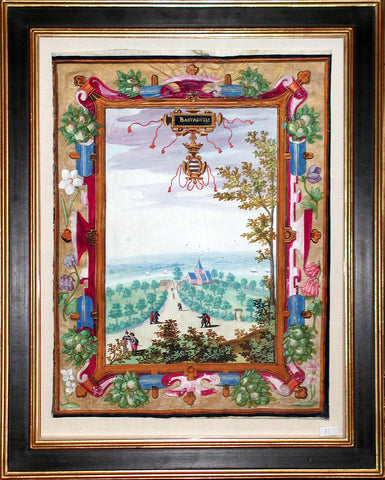

Alfred Jacob Miller (1810-1874), Lake in the Wind River Mountains
Alfred Jacob Miller (1810-1874)
Lake in the Wind River Mountains
Gouache, watercolor, and pencil on paper
Paper size: 9 1/8 x 12 7/8 inches
Framed size: 18 1/4 x 22 1/4 inches
Signed "Miller", lower left
ca. 1837
Lake in the Wind River Mountains was likely executed following Alfred Jacob Miller’s landmark 1837 expedition to the Rocky Mountain West with his patron and friend, Sir William Drummond Stewart, a Scottish soldier, aristocrat, and noted sportsman. Stewart invited Miller to accompany him on an extended journey to the annual Rocky Mountain Fur Rendezvous, held that year along the Green River in present-day Wyoming. The expedition made Miller the first professionally trained American artist to travel into the central Rocky Mountains and document the region from direct observation. Although this was the only journey west of the Mississippi that Miller ever undertook, it profoundly shaped his artistic legacy. The sketches and field studies he produced during the expedition became the foundation for an extraordinary body of watercolors and oil paintings that established him as one of the foremost visual chroniclers of the early American frontier.
The 1837 fur rendezvous marked the closing chapter of a defining era in the history of the American West. Beginning in the 1820s, the annual rendezvous served as gathering places where trappers, traders, Indigenous nations, and suppliers met to exchange furs, provisions, and news. By the late 1830s, however, the beaver trade was rapidly declining due to changing fashions in Europe and the depletion of beaver populations. Miller’s journey therefore coincided with one of the last great rendezvous of the Rocky Mountain fur trade, preserving in both words and images a way of life that would soon disappear. His paintings and journals constitute an invaluable historical record of the mountain men, Native American tribes, traders, and landscapes that characterized this pivotal moment in the nation’s westward expansion.
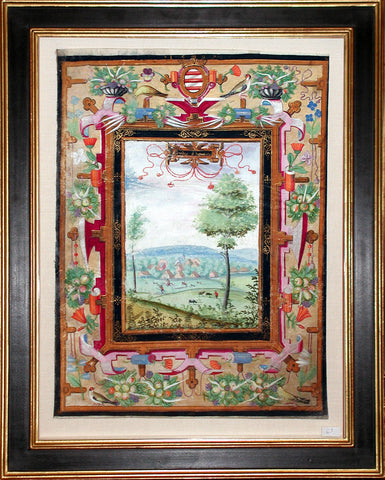
This watercolor captures the pristine beauty of the Wind River Mountains, one of North America’s most spectacular alpine landscapes. Stretching for more than 100 miles across western Wyoming, the Wind River Range is distinguished by soaring granite peaks, expansive glacial valleys, hundreds of crystal-clear alpine lakes, and some of the largest remaining glaciers in the Rocky Mountains outside Alaska. Home to Gannett Peak, Wyoming’s highest summit, the range is celebrated for its dramatic scenery, ecological diversity, and enduring wilderness character. During Miller’s visit, this remote landscape remained largely unknown to Euro-American audiences, its valleys and high mountain lakes familiar primarily to the Eastern Shoshone and other Indigenous peoples, as well as a small number of trappers, traders, and explorers.
The present work exemplifies Miller’s remarkable ability to combine careful topographical observation with a romantic sensitivity to atmosphere and light. Working in gouache, watercolor, and pencil, he conveys both the grandeur and serenity of the alpine landscape, transforming firsthand sketches into compositions that celebrated the sublime character of the American wilderness. Unlike many later artists who relied on secondhand accounts or imagined western settings, Miller painted from direct experience, lending his works an unusual degree of authenticity while retaining their poetic appeal.
Today, Miller is recognized as one of the most important artists in the development of the iconography of the American West. Created decades before the celebrated western paintings of Albert Bierstadt and Thomas Moran, his images established many of the visual themes that would come to define the frontier in the American imagination: sweeping mountain vistas, pristine wilderness, Indigenous communities, trappers and explorers, and the spirit of adventure associated with the trans-Mississippi West. His paintings provided Eastern audiences with some of their earliest visual encounters with the Rocky Mountains and helped shape a national perception of the West as both a place of sublime natural beauty and a land of exploration and possibility.
We Also Recommend