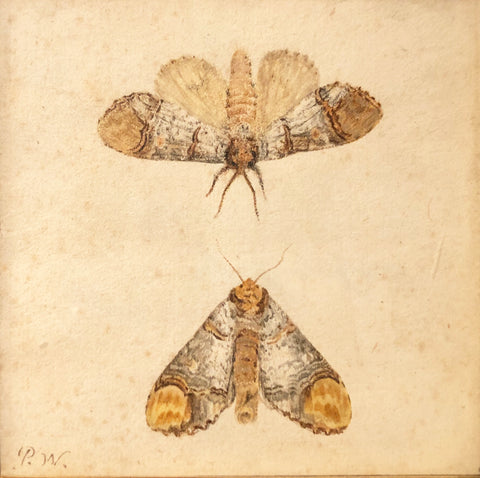
Pieter Withoos (Dutch, 1654-1693), Pale Tussock moth (Calliteara pudibunda, formerly Dasychira pudibunda) and Large Yellow Underwing (Noctua pronuba)
Pieter Withoos (Dutch, 1654-1693)
Pale Tussock moth (Calliteara pudibunda, formerly Dasychira pudibunda) and Large Yellow Underwing (Noctua pronuba)
Pen and brown ink and watercolor on off-white laid paper; ruled border in black ink
Signed with initials in brown ink on lower left recto ‘P.W.’
Paper size: 3 1/2 x 3 3/4 in.
Framed size: 5 x 5 1/8 in.
Provenance: James Sansum Fine and Decorative Arts.
#AP02593
The two specimens are arranged in a vertical composition with each moth presented in a full dorsal spread, antennae extended, as if freshly pinned.
The upper moth is the more dramatically rendered of the two. This specimen closely resembles the Pale Tussock moth (Calliteara pudibunda, formerly Dasychira pudibunda), specifically the female, which is notably larger and paler than the male. Native across much of Europe, including the Netherlands, it inhabits deciduous woodland and hedgerows. Its larvae feed on a wide range of broadleaf trees, including oak, beech, and hop, making it familiar to any attentive observer of the Dutch countryside in the seventeenth century. Shown here with its forewings broad and spread wide, painted in a palette of buff, pale cream, and warm gray, overlaid with fine brown mottling and darker transverse banding. The wingtips carry pronounced dark chestnut patches, lending the wings a tattered, bark-like quality. Above the thorax, what appear to be raised hindwings or prominent dorsal tufts fan outward in a pale, almost scalloped arrangement, giving the insect an unusually theatrical silhouette. The abdomen is striped in ochre and brown, and the delicate legs are rendered with a fine brush in warm rust tones.
The lower moth is smaller, darker, and more tightly composed. This specimen’s coloring is consistent with a moth from the Noctua genus, most plausibly the Large Yellow Underwing (Noctua pronuba), one of the most abundant noctuids across Europe and a thoroughly common inhabitant of gardens, meadows, and woodland edges throughout the Netherlands. The vivid hindwing coloration, concealed at rest and revealed in flight, was long thought to startle predators, a behavioral adaptation that would have been of keen interest to naturalist-collectors of the period. Drawn with its forewings a rich gray-brown with intricate darker mottling and subtle transverse lines, evoking the look of tree bark or weathered stone. The most striking feature is the hindwing, which peeks from beneath the forewing at each lower corner in bold patches of warm ochre and burnt amber. The thorax is golden-brown, and the antennae are rendered as two delicate filiform threads curving upward toward the upper moth’s legs, creating an incidental diagonal axis that animates the otherwise static composition.
Withoos may have intended the two specimens as a male-female pair of the same species rather than two entirely distinct moths. The Pale Tussock moth exhibits pronounced sexual dimorphism, with females significantly larger, paler, and broader-winged. The upper moth’s greater size and paler coloring would be consistent with the female, and the lower moth’s darker, more compact appearance could represent the male. This pairing convention was common in seventeenth-century entomological illustration, where artists sought to document both sexes for completeness.
In the context of the Dutch Golden Age, insects occupied a surprisingly elevated cultural position. The explosion of trade, the establishment of the VOC and WIC, and the circulation of exotic specimens through Amsterdam’s markets created an intense appetite for natural curiosities. Cabinets of curiosities (Wunderkammern and kunstkamers) filled with pinned insects, shells, minerals, and dried specimens were markers of wealth, learning, and cosmopolitan taste. Butterflies and moths were among the most sought-after items, prized both for their visual beauty and for the symbolic freight they carried: the metamorphosis of the caterpillar into the winged adult was a well-worn emblem of the soul’s transformation and resurrection.
While the gaudy tropical butterflies imported from Suriname and the East Indies commanded the highest prices, European species were by no means without value. A fine, well-preserved specimen of a Pale Tussock moth or a Large Yellow Underwing would have been a creditable addition to a local collection, particularly when rendered in the kind of exacting, luminous watercolor that Withoos provides here. Such drawings themselves were collectible objects, serving as permanent visual records of specimens that might fade or disintegrate over time.
What this small work offers is something beyond taxonomy: a quality of stillness and attention, a sense that these two creatures have been observed with genuine curiosity and rendered with evident care. The warm paper, the restrained palette of tans, grays, and ochres, and the precise but never sterile brushwork make the painting as much a meditation on texture and camouflage as a scientific record.
PIETER WITHOOS (DUTCH, 1654/55 – 1692/93)
Pieter Withoos was an outstanding natural history painter whose brief career produced some of the finest watercolor studies of birds, insects, and flowers to emerge from the late Dutch Golden Age. Working primarily in Amsterdam and Utrecht during the final decades of the seventeenth century, he brought to the intimate format of the collector’s album a degree of technical precision that set him apart from many contemporaries working in the same vein. Withoos died at approximately thirty-eight years of age, leaving a body of work that, though relatively modest in extent, stands as a testament to the extraordinary standard of natural history illustration then flourishing in the Dutch Republic.
Withoos came of age during a moment of intense intersection between art and natural science. The Vereenigde Oost-Indische Compagnie (VOC, the Dutch East India Company) continuously delivered exotic plants, birds, and insects from the Far East, the Americas, and beyond into Amsterdam, feeding a voracious appetite for collecting among the Republic’s wealthy merchant class. Botanical gardens in Amsterdam and Leiden cultivated rare species, while private collectors maintained their own gardens and cabinets of curiosities and commissioned artists to
document them. These albums served simultaneously as works of art, scientific catalogs, and instruments of social prestige, creating sustained demand for painters who could combine botanical accuracy with genuine pictorial refinement.
Pieter was trained entirely within his own family alongside his siblings Johannes, Frans, Maria, and Alida. His father, Matthias Withoos (1627–1703), was a formidably educated artist who had studied first under the architect-painter Jacob van Campen (1595–1657) at his school at Randenbroeck outside Amersfoort, and subsequently under Otto Marseus van Schrieck (1619/20–1678), the celebrated pioneer of the sottobosco (“forest floor”) genre, whose darkly lit compositions of reptiles, insects, and plants among tangled undergrowth became a touchstone for natural history painters of the period. When French troops occupied Amersfoort during the Rampjaar (Disaster Year) of 1672, the family relocated to Hoorn. Pieter subsequently lived in Utrecht through the 1680s before settling in Amsterdam.
From the late 1680s, Pieter’s most significant patron was Agnes Block (1629–1704), one of the most remarkable figures in Dutch horticultural and artistic history. Known throughout the Republic as “Flora Batava” (the Dutch Flora), Block was a prosperous Mennonite botanist, horticulturalist, and art collector who transformed her country estate, Vijverhof, on the River Vecht, southeast of Amsterdam, into a celebrated botanical garden. There she cultivated rare and exotic species obtained through the VOC’s global trade networks, and in 1687 she became the first European to grow a pineapple to fruit outside its native habitat. To document the extraordinary specimens in her garden, Block commissioned more than four hundred watercolors, assembling them into her celebrated Bloemenboek (Flower Book), a folio album that served simultaneously as a catalog and as an assertion of her identity as a serious naturalist. Among the artists she retained were Maria Sibylla Merian, Johannes Bronkhorst, Herman Henstenburgh, and both Pieter and his sister Alida Withoos. Block required artists of the highest technical precision: her watercolors were intended as permanent scientific and artistic records of living specimens that were ephemeral, rare, or impossible to preserve in any other form. Both Pieter and Alida had the opportunity to work directly with the exotic birds and plants at Vijverhof, including species introduced to Holland by the VOC. The estate’s renown as a center of artistic and scientific life was celebrated by Block’s cousin Gualtherus Blok in his poem Vyver-hof van Agneta Blok, an encomium to Vijverhof that attests to the estate’s singular position within Dutch cultural life.
Withoos worked almost exclusively in watercolor, a medium particularly suited to capturing the luminous translucency of flower petals and the iridescent shimmer of insect wings. Each sheet is executed with meticulous draftsmanship, every feather barb, petal vein, and wing scale rendered with care that speaks to his training in a family workshop defined by exacting naturalism. Drawings by Pieter Withoos are rare on the art market; a notable watercolor of a snipe survives in the Rijksprentenkabinet in Amsterdam, and his sheets are typically signed with the monogram “P.W. fc.” Arnold Houbraken, in his De groote schouburgh der Nederlantsche konstschilders en schilderessen (The Great Theater of Netherlandish Painters and Paintresses), published between 1718 and 1721, characterized Pieter as a painter who worked in watercolors, rendering flowers and all manner of small insects and animals, primarily for the albums of garden collectors , a characterization that precisely captures the collector culture in which Pieter Withoos practiced his art.
We Also Recommend