

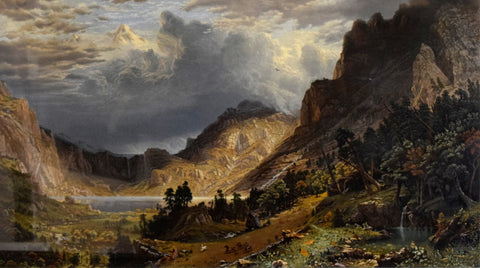
Albert Bierstadt (1830-1902), The Domes of the Yosemite
Albert Bierstadt (1830-1902)
The Domes of the Yosemite
c. 1868
Chromolithograph
Sheet size: 21 1/4 x 32 3/8 in.
The Domes of the Yosemite was the last of Bierstadt's chromolithographs to be printed, and its development and means of publication differed somewhat from any of his other print ventures. The work was derived from a painting commissioned in 1866 by Le Grand Lockwood for the octagonal rotunda of his mansion in Norwalk, Connecticut. However, the enormous size of the painting -- nine feet by fifteen feet -- made it an impossible model for the chromolithograph. Instead, Bierstadt painted a smaller version of The Domes of the Yosemite, which he exhibited in London at McLean's Gallery between April and May 1868. Bierstadt and his wife had spent the period between 1867 and 1868 living in London and his three paintings, The Domes of the Yosemite, Storm in the Rocky Mountains, Mt. Rosalie and The Rocky Mountains, Lander's Peak were the toast of England. Indeed, Bierstadt had received an invitation from Queen Victoria, in December of 1867, to accompany his two Rocky Mountain panoramas to Osborne House on the Isle of Wight for a royal audience. The artist noted that Her Majesty "seemed much pleased with my works."
After its London debut, the painting of The Domes of the Yosemite was sent to Düsseldorf where it became the model for this spectacular chromolithograph. Unlike his other prints, he chose a German print firm, Breidenbach, to produce it. His decision was perhaps based upon the superlative quality of German printmaking at this time. The chromolithograph of The Domes of the Yosemite was available for sale in New York by the autumn of 1870 and was advertised at both Sarony's gallery and E. & H. T. Anthony and Co. Its price far exceeded that of any other print and was listed at twice the price of other German-made landscape subjects. However, its amazing quality was commented upon in the Bulletin, which called the image "the grandest effort of this eminent artist."
Peter Marzio includes discussion of this work in his book, Democratic Art regarding the fine quality of the chromolithography.
We Also Recommend
![Arthur Burdett Frost (1851-1928), “5” [A Western Scene]](http://aradergalleries.com/cdn/shop/products/Unititled_man_with_horses_and_top_hats_large.jpg?v=1491240574)
