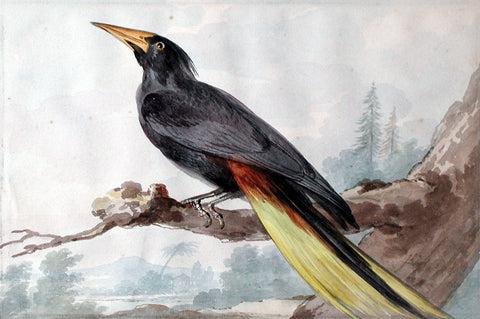

William Matthew Hart (British, 1830-1908), Common Pheasant; Phasianus colchicus Linnaeus
The Common Pheasant is native to Asia, from the Caucasus and the Caspian region east across Central Asia to China, Korea, and Japan. The nominate race colchicus, the bird of ancient Colchis on the Black Sea from which the name derives, lacks the white neck ring of the eastern species. The Romans probably brought it to Britain; it was certainly established by the eleventh century, and the ring-necked Chinese species joined it later, imported in the late eighteenth century. The two interbred freely, and by Gould’s day the bird was already largely a mixture.
Gould did not regard the pheasant as a British bird at all, and he included it only because his subscribers asked him to. For the Victorian landowner, however, the pheasant was the most important bird in the countryside. The rise of driven shooting and the rearing of birds in great numbers made the pheasant the center of the shooting estate, the gamekeeper’s chief charge, and the poacher’s prime target. The Game Act of 1831 and the Poaching Prevention Act of 1862, passed the year the first part of The Birds of Great Britain appeared, testify to the intensity of the conflict that Hart’s drawing records quietly.
In this spectacular watercolor Hart’s mastery of plumage is fully displayed. A cock pheasant lies dead in the snow, caught by the neck in a poacher’s wire snare tied to a bent stick; its long barred tail sweeps across the upper left of the sheet, and its copper and gold body feathers, each edged in black, glow against the cold white ground. A drop of blood stains the snow beside the bill. In the distance, two living pheasants, cock and hen, pick their way through the snowy undergrowth. The luminous, metallic qualities of the plumage are rendered with Hart’s characteristic glazes of gum arabic, which deepen the greens and violets of the head and the bronze of the flanks.
The subject is unusual in Gould’s work, which rarely depicts death, and it reflects the realities of the Victorian game preserve. Hart has chosen the black-necked bird without a white collar, the form Gould considered the “true” Phasianus colchicus, and his text explains the choice. The pencil note “4.12” in the lower margin matches the plate’s position in the fourth volume of The Birds of Great Britain. The drawing comes from the collection of Frederick DuCane Godman, coauthor of the Biologia Centrali-Americana (Biology of Central America) and one of the founders of the British Ornithologists’ Union.
Gould’s text opens with an unusually personal statement of editorial policy:
In accordance with the expressed wishes of a great number of the subscribers to the present work, I here give a figure and description of the Common Pheasant. For my own part I consider it as much out of place in the ‘Birds of Great Britain’ as it would be to include therein similar delineations of the Peacock, the Turkey, and several other birds which have at various periods been introduced.
He describes the plate as showing a “true Phasianus colchicus, which has met with a fate to which hundreds of its brethren are annually subjected,” a dry reference to the poacher’s snare, and he places the bird’s “true habitat” in “Asia Minor and the western portion of Asia.”
WILLIAM MATTHEW HART (BRITISH, 1830-1908)
The talented natural history painter William Matthew Hart was the artistic genius behind some of the lavish illustrations for John Gould’s splendid work The Birds of Great Britain and A Monograph of the Trochilidae or family of Hummingbirds.
He began working for Gould in 1851, beginning an association that was to last thirty years. Early during this period, he made the patterns for the lithographic plates for Gould’s work on hummingbirds and working on The Birds of Great Britain with Henry Constantine Richter. By 1870 Hart had become Gould’s chief artist and lithographer. After Gould died in 1881, Hart was employed by Richard Bowdler-Sharpe of the British Museum to complete Gould’s work on the birds of New Guinea and to produce illustrations for Sharpe’s monograph on the birds-of-paradise.
Hart is roundly regarded as Gould’s most devoted protegé and his most accomplished artist, drawing upon Gould’s incomparable legacy of research and craftsmanship to create a splendid tribute to Gould and his favorite birds.
Please feel free to contact us with questions by phone at 215.735.8811,
or by email at loricohen@aradergalleries.
We Also Recommend