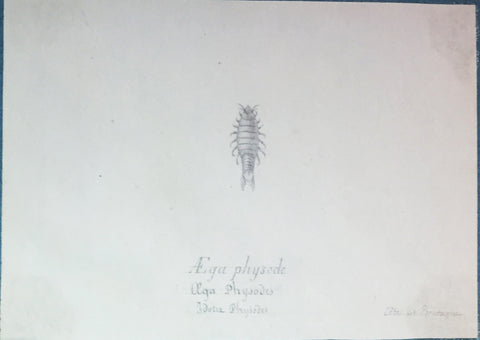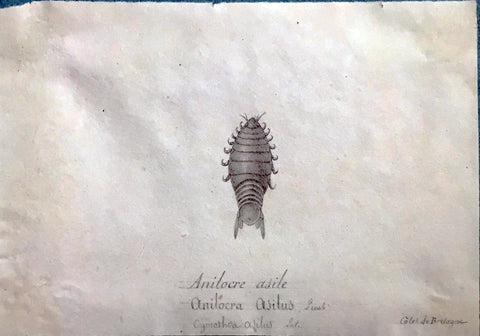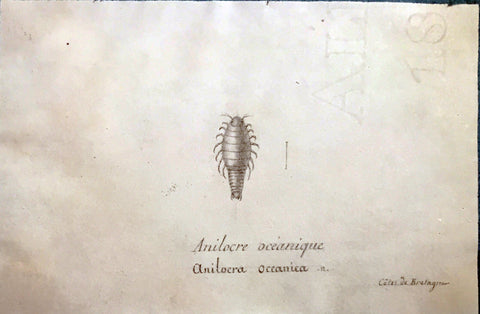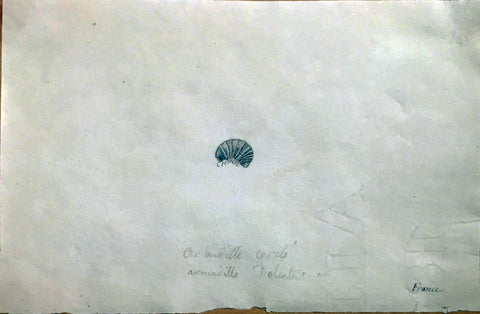
ATTRIBUTED TO JACQUES DE GHEYN II (DUTCH, c. 1565–1629), Study of a Dragonfly
Attributed to Jacques de Gheyn II (DUTCH, c. 1565–1629)
Study of a Dragonfly
Pen and brown ink on off white laid paper
Paper watermarked with an armorial cartouche with Strasbourg bent and letters
Paper size: 3 5/8 x 5 5/8 in.
Frame size: 8 1/4 x 9 1/2 in.
#AP02222
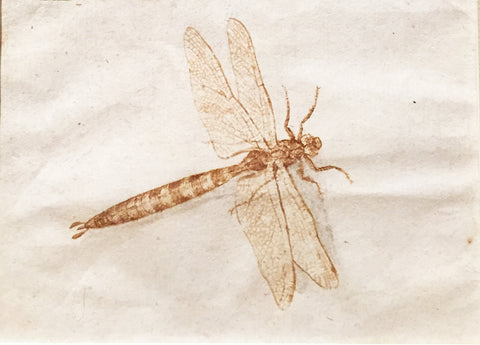
De Gheyn’s dragonfly showcases his technical prowess as a draftsman. He employed a combination of bold and gentle lines to represent the subject, achieving a balance between scientific precision and artistic sensitivity characteristic of Northern European naturalism.
Rendered in warm brown ink on aged paper, the drawing places the dragonfly at a slight diagonal, its elongated abdomen stretching toward the lower left while the thorax and head anchor the composition near the center-right. The arrangement lends the image a sense of arrested motion, as though the insect has just alighted and might take flight again at any moment.
The wings are the most technically accomplished passage in the drawing. De Gheyn traces their membranous surfaces with an extraordinarily fine network of veins, capturing the translucent fragility of the actual tissue. The abdomen receives equally careful attention, its segmented structure conveyed through alternating areas of deeper and lighter ink that suggest the insect’s cylindrical form tapering to a fine point. The wiry, precise strokes of the legs and antennae complete the portrait with a kind of nervous energy, affirming De Gheyn’s remarkable ability to observe and translate living nature onto the page.
JACQUES DE GHEYN II (DUTCH, c. 1565–1629)
Jacques de Gheyn II stands as one of the greatest Dutch draftsmen of the generation before Rembrandt, a pivotal figure whose career spans the transition from Northern Mannerism to the observational naturalism that would define the Dutch Golden Age. Working across drawing, engraving, painting, and watercolor, de Gheyn produced an oeuvre of over 1,500 works remarkable for its range, technical virtuosity, and intellectual ambition.
De Gheyn’s career unfolded during an extraordinary moment of transformation in European culture. The newly independent Dutch Republic was emerging as a center of trade, learning, and artistic innovation. Leiden University, founded in 1575, had become a leading site for the study of natural history, botany, and anatomy, drawing scholars such as the botanist Carolus Clusius, whose work helped organize the classification of the natural world through precise visual description. Artists and scientists alike embraced the idea of working naer het leven (from the life), a phrase that carried both epistemological and social weight in learned circles, signaling fidelity to direct observation over inherited convention. De Gheyn was at the very center of this culture, and his draftsmanship gave visible form to the era’s passion for close empirical inquiry.
Born in Antwerp, de Gheyn received his first training from his father, a glass painter, miniaturist, and print designer. In 1585, after his father’s death, he entered the workshop of Hendrik Goltzius in Haarlem, where he remained for five years before establishing his own printmaking business, where he made prints after his own and other artists’ designs. The Goltzius years were formative: before 1600, de Gheyn’s style was clearly influenced by his teacher, whose small silverpoint and metalpoint portraits on ivory-colored tablets de Gheyn imitated, though he used a yellow ground and rendered his sitters more gracefully and dynamically. De Gheyn’s draftsmanship, rooted in his printmaker’s training, drew on the tradition of Dürer, Pieter Bruegel the Elder, and Lucas van Leyden. In 1595, he married into a wealthy family, achieving financial independence. He and his new wife settled in the university town of Leiden, where de Gheyn associated with some of the leading humanists and scientists of the day. There, he collaborated with the law scholar Hugo de Groot (Grotius), who wrote inscriptions for several of the artist’s engravings.
The art theorist Karel van Mander, writing in his Schilder-Boeck of 1604, observed that de Gheyn “did much from nature and also from his own imagination, in order to discover all available sources of art,” capturing the productive tension between direct observation and creative invention that defines the artist’s output.
De Gheyn’s patrons in The Hague included Prince Maurice of Orange-Nassau and his court. Around 1600, Emperor Rudolf II of Prague also collected his work. Rudolf II, was the great collector-emperor of Prague, whose Kunstkammer gathered the rarities of the natural and man-made world. For Rudolf, de Gheyn’s images functioned as surrogate specimens, extending the reach of the imperial collection into microscopic and unseen corners of the natural world.
For his drawings, de Gheyn often used a quill pen and dark brown ink with white heightening, black or red chalk, or brush and wash. The mastery of his natural history subjects lay in “handling his inked pen sparingly or more generously and allowing it to glide in time with his ideas,” employing hatching in multiple directions to build form and atmosphere without the flowing, swelling lines of his Goltzius period.
De Gheyn’s pursuit of natural history took on new urgency with the invention of the microscope. His neighbor, the humanist Constantijn Huygens, provided de Gheyn access to Cornelis Drebbel’s newly constructed instrument around 1620. Writing to the artist with wonder, Huygens exclaimed: “It really is as if you stand before a new theatre of nature, or you are on a different planet.” Huygens urged de Gheyn to undertake a series of microscopic studies of Creation. The project began but was never completed; de Gheyn died in The Hague on 29 March 1629.
We Also Recommend